WELL INTO MY FIRST WEEK...the journey has been long and varied and I am now well and truly "down under", almost diametrically through the center of the earth from where I started, driving from Painted Post NY to Basalt CO, then flying to San Francisco (SFO) to enjoy time with friends there before departing.
MY GOOD FRIEND, Dr Francis Wright, went with me to SFO via BART (Bay Area Rapid Transport), virtually from one end of the Bay area to the other, helping me with my now quite heavy suitcases. How good to have friends who provide support at just the right times! The flight lasted about 14 hours leaving around 11 PM and arriving in Sydney 6:45 AM. I passed the time reading, dozing, talking with my young seat companion, a geology student at University of Washington State, or walking about the cabin getting in knee exercises. This also provided protection against the possibility of deep vein thrombosis (DVT), for old codgers like me a serious threat during long periods of seating.
Once in Sydney, I was very much in the arms of my family…my son Andrew and his two sons, my nephew Peter and his family, and my brother, Norton.
I seem to have stood up to my travels pretty well and enjoyed a walk around the block with my nephew, the surroundings ablaze with spring flowers and smitten with the loud sounds of the many birds, on what became increasingly a perfect Sydney spring day.
Thanks for the many good wishes you nave sent me by email. This is a serious time in my life…as Elizabeth (Peter’s wife) remarked, ‘Robert, you are virtually homeless for the time being!’ So then to the work of settling in and settling down. First on the agenda is the purchase of a car. Another of my nephews, Zintis, a qualified mechanic, is assisting me. We have already had a look at one; we make a smooth team. I engage the owner while Zintis goes about his careful inspection and evaluation.
My knee continues to improve and I am able to go down stairs symmetrically now. Getting in lots of walking.
Not much more of interest for the time being. Regards and good wished to you all.
Tuesday, September 21, 2010

Thursday, September 16, 2010
LAST DAY IN THE USA
IT'S THURSDAY SEPTEMBER 16 and a very pleasant afternoon here in Walnut Creek, sunny California (although some rain may be possible over the weekend).
Around about 6 PM, my good friend Francis and I will take the BART out to SFO International Airport. My flight out to Sydney leaves around 10:30, so this will give me enough time for the check in procedures.
It was a long day getting here from Basalt, due to the long stopover at Denver. Up around 3 AM Pacific time and into bed about 10:30 PM. I felt very sad leaving Aspen, saying goodbye to my little family there after four great days seeing what a wonderful young woman my eldest granddaughter has become.
Staying with my friends, Mary and Francis Wright, has been very relaxing and restorative. I am very grateful to them for this pleasant, quiet and enriching time. As ever, we have had deep conversations and I have some new authors to follow through on. Two streams of luggage converged here, the stuff I had sent ahead via UPS and my stuff from Basalt. Lots of 'needle work' separating what I really need to take to Australia and what must be left behind to benefit the local Goodwill.
I am really down to two suitcases for checking (one containing my folding Bike Friday), a computer case, and one other carry-on bag...pretty amazing, really!
So this last blog posting in the USA on a very pleasant afternoon. A very long night and I will be in Sydney. Winnowing the stuff had me immersed in the business of discarding what really had to do with my life here and what I really need to begin anew in Australia. Truly, passing through the needle strips all but the necessities. I arrived in the US on 19 February 1995, making about 15 and one half years here, richer in many ways with experiences and new friends.
Next posting from Sydney. 'Adieu' and 'au revoir', to return in late January, moving into longer and warmer days as the Australian summer bears down.
Around about 6 PM, my good friend Francis and I will take the BART out to SFO International Airport. My flight out to Sydney leaves around 10:30, so this will give me enough time for the check in procedures.
It was a long day getting here from Basalt, due to the long stopover at Denver. Up around 3 AM Pacific time and into bed about 10:30 PM. I felt very sad leaving Aspen, saying goodbye to my little family there after four great days seeing what a wonderful young woman my eldest granddaughter has become.
Staying with my friends, Mary and Francis Wright, has been very relaxing and restorative. I am very grateful to them for this pleasant, quiet and enriching time. As ever, we have had deep conversations and I have some new authors to follow through on. Two streams of luggage converged here, the stuff I had sent ahead via UPS and my stuff from Basalt. Lots of 'needle work' separating what I really need to take to Australia and what must be left behind to benefit the local Goodwill.
I am really down to two suitcases for checking (one containing my folding Bike Friday), a computer case, and one other carry-on bag...pretty amazing, really!
So this last blog posting in the USA on a very pleasant afternoon. A very long night and I will be in Sydney. Winnowing the stuff had me immersed in the business of discarding what really had to do with my life here and what I really need to begin anew in Australia. Truly, passing through the needle strips all but the necessities. I arrived in the US on 19 February 1995, making about 15 and one half years here, richer in many ways with experiences and new friends.
Next posting from Sydney. 'Adieu' and 'au revoir', to return in late January, moving into longer and warmer days as the Australian summer bears down.
Friday, September 10, 2010
KNEE #2 UPDATE & THE NEEDLE'S EYE
SEVEN WEEKS have come and gone. The surgeon is happy with progress, as is the physical therapist. I, lacking rationality when it comes to rehabilitation, think that things are going too slow but have learned from the last bout that it is unwise to push too hard. Even so, there have been some moments that caused concern, none of which count being now past. The first knee, surgery and rehabilitation and all, appears to have left me somewhat depleted and my fitness level had slipped by the time of the second procedure, leading to some small complications. What this means is that is wise indeed to have a good interval between the first and the second. Keep this in mind should you or someone you know is contemplating serious surgery.
Which brings me to the Needle's Eye.
Whatever your view of Jesus, his sayings (which are the core of Christian practice) can be very pertinent. In one of the gospels (John), he is depicted in deep conversation with a Jewish Rabbi who came secretly to confer with him. The Rabbi was concerned about how one can live a life that is pleasing to God. The Bible has a lot to say about this, none of which Jesus repeated. What he said was, "One must be born anew to enter the kingdom of God." In another gospel (Mathew) Jesus is reported saying that it is easier for a camel to pass through the eye of a needle than for a rich man to enter the kingdom of God.
When you think about it, being born anew or threading a needle can be exceedingly constricting . You have to be or become small in certain ways to make it through.
Whatever biblical commentators make of these sayings (I recommend you Google them), I seem to be in an ever constricting process. Now in Colorado, visiting with my elder daughter and her daughter, I have filtered out a lot of "stuff" leaving Painted Post. I shall divest myself of more during this visit. By the time I reach San Francisco, I will be down to two regular suitcases and carry on bags.
While we are thinking along these lines, one might well ask, "Well then, what is this 'kingdom of God'? As one who tends either agnostic or else atheistic, I take this to mean the life that you really want to live but may feel held back from by reason of unsuitable beliefs, attitudes, habits, and the press of life. Jesus was not concerned with possessions. From his perspective, preoccupation with possessions and riches must have seemed somewhat absurd, particularly if these stood in the way of the life we would wish above all else to be able to live.
So it does one good from time to time to divest all but the essentials. This can happen if one is robbed, or a fire consumes all, or when one moves, as I am doing. Having been robbed three times, apart from annoyance and some grief for things lost, it did appear to me that there could be a positive side. Pioneers who trekked across continents or risked all across oceans learned this lesson.
To go on to the good life can mean leaving much behind. You have to be prepared to let go, even renounce much that seemed to be important.
So far I have driven three days from Painted Post to be with my daughter, making my fourth semi-transcontinental crossing. I am sad to be leaving so much that is good and valuable behind. Passing through the needle's eye is not without pain. I shall miss being each day with my lovely friend, Uma, but we plan that our paths will cross from time to time while we support each other in the paths we must tread in the meantime.
For me, the biggest loss is friends I have made along the way. While travel permits, some at least of you might have to bear an occasional visit from me. Nowadays we have this marvelous Internet so you will continue to hear of me through this Blog. I plan to get better at blogging. I am getting to see that regular updates in Facebook can really work. If you are not on Facebook, give it some serious consideration. That way I will get to hear of you.
I am here at Basalt for three more days and then go on to stay with my friends, Frank and Mary Wright, in San Francisco for a day or two before boarding United Airlines on Thursday night arriving in Sydney on their Saturday morning. My life in America will be behind me, having arrived here as an immigrant on February 19, 1995. Only one or two visits each year remain. On the other hand, I am looking forward to completing my apprenticeship as a grandfather and plan to have my grandchildren remember me a supportive and interesting person.
So it is almost farewell to my life in America, almost time to say, 'Goodbye'.
Sunday, August 22, 2010
THE CONNECTEDNESS OF THINGS
WHAT REALLY BOTHERS ME is judging how best to react to a crisis like the great BP Oil Spill. This is a US located disaster and quite a few of the readers of this Blog live far away. Even here in Painted Post, in Upper New York State, it is hard to grasp the gigantic effects of this disaster on the life and ecology this is having and will continue to have. On the other hand, it is hard indeed not to feel some sense of connection to it. Why are BP and similar companies drilling for oil off-shore in the Gulf of Mexico? There some 50,000 drilling sites abound, over half of them capped, abandoned, and un-monitored; only some 600 are related to BP activity. We hardly need to be told this is a risky business in terms of human lives; when I fill up at the local service station it is hard not to think of eleven lives vanished at Deepwater Horizon. In terms of financial risk oil drilling cost billions and only relatively few exploration holes become productive. The per barrel extraction costs keep rising and the amount of oil reserves found keep falling. Yet still we drill for drill we must; and the reason we must is that the demand for petroleum products will continue to rise as more internal combustion vehicles come on the world increasing number of highways.
What can we do? One possible response is outlined in an NY Times OpEd article, This Time It Is Different (June 12, 2010 http://www.nytimes.com/2010/06/13/opinion/13friedman.html) in which Thomas Friedman quotes a letter to the editor written by a friend to his local paper. In part, his friend says, "Here's the bottom line: if we want to end our oil addiction, we, as citizens, need to pony up: bike to work, plant a garden, do something. So again, the oil spill is my fault. I'm sorry. I have not done my part." However true this may be, it is far too simple a 'mea culpa'. A large proportion of the working population have been seduced into living far from their work place and must rely on owning and using a car to get to and from from work. The construction of modern suburbs prevents students from walking or riding bikes to and from school and recreation. It is far cheaper to buy a tomato at the supermarket that to grow one at home, even including the cost of driving. Besides, what I do or don't do is a drop in the bucket compared with what others don't do and do.
Maybe a growing consciousness about the cost of things is needed. Perhaps I should think about the eleven dead at Deepwater Horizon when I gas up my car, or the 29 coal miners dead in Pennsylvania when I turn on the light. Or the 35 to 47 $Billion the oil industry receives each year so that I can have relatively cheap gasoline that makes it possible for me to make four trips downtown a week instead of three, or two.
Today I saw a documentary ('Blood, Sweat, and T-Shirts') in which six young Brits went to India to work in the clothing industry that supplies Europe's fashion shops, living and working in the same conditions as Indian workers. It was a trying and testing experience in which they discovered the harsh discipline workers must endure, that the 'bargain' costing 15 Pounds at home resulted in 33 Rupees (about US$0.45) to the worker who assembled it and who must make 16 garments a day to scape together enough for the necessities of life. In the globalization made possible by cheap oil, garments purchased on 'the cheap' in the developed world, worn once or twice before being discarded, mean a cheap life for those who make them.
Discovering the world beyond what is under our nose can be a shocking experience. Caught up in the web of our own existence, we struggle to understand how things might be different for others if we changed our own behavior. Things might be worse, not better...how can we know?
A couple of things stand out for me. We need to be a lot smarter about how the world of economics and politics 'works' and those of us who are finding out more need to spread the word so as to influence our 'masters and betters'.
Just now, in Australia, in last weekend's election, the governing party may have lost power because it dropped the ball on action to combat global warming. Here in the US, we face the awful consequences of an oil disaster that could have been prevented by better regulation and administration of the industry. Perhaps we are beginning to realize that, for democracy to appear, citizens need to be well versed over issues, to take time from Fox news and 'reality TV' and get busy 'googling'. Maybe we need a Church of the Environment, a religion of the Internet to rescue us from ageing political slogans, and...who knows what?
What can we do? One possible response is outlined in an NY Times OpEd article, This Time It Is Different (June 12, 2010 http://www.nytimes.com/2010/06/13/opinion/13friedman.html) in which Thomas Friedman quotes a letter to the editor written by a friend to his local paper. In part, his friend says, "Here's the bottom line: if we want to end our oil addiction, we, as citizens, need to pony up: bike to work, plant a garden, do something. So again, the oil spill is my fault. I'm sorry. I have not done my part." However true this may be, it is far too simple a 'mea culpa'. A large proportion of the working population have been seduced into living far from their work place and must rely on owning and using a car to get to and from from work. The construction of modern suburbs prevents students from walking or riding bikes to and from school and recreation. It is far cheaper to buy a tomato at the supermarket that to grow one at home, even including the cost of driving. Besides, what I do or don't do is a drop in the bucket compared with what others don't do and do.
Maybe a growing consciousness about the cost of things is needed. Perhaps I should think about the eleven dead at Deepwater Horizon when I gas up my car, or the 29 coal miners dead in Pennsylvania when I turn on the light. Or the 35 to 47 $Billion the oil industry receives each year so that I can have relatively cheap gasoline that makes it possible for me to make four trips downtown a week instead of three, or two.
Today I saw a documentary ('Blood, Sweat, and T-Shirts') in which six young Brits went to India to work in the clothing industry that supplies Europe's fashion shops, living and working in the same conditions as Indian workers. It was a trying and testing experience in which they discovered the harsh discipline workers must endure, that the 'bargain' costing 15 Pounds at home resulted in 33 Rupees (about US$0.45) to the worker who assembled it and who must make 16 garments a day to scape together enough for the necessities of life. In the globalization made possible by cheap oil, garments purchased on 'the cheap' in the developed world, worn once or twice before being discarded, mean a cheap life for those who make them.
Discovering the world beyond what is under our nose can be a shocking experience. Caught up in the web of our own existence, we struggle to understand how things might be different for others if we changed our own behavior. Things might be worse, not better...how can we know?
A couple of things stand out for me. We need to be a lot smarter about how the world of economics and politics 'works' and those of us who are finding out more need to spread the word so as to influence our 'masters and betters'.
Just now, in Australia, in last weekend's election, the governing party may have lost power because it dropped the ball on action to combat global warming. Here in the US, we face the awful consequences of an oil disaster that could have been prevented by better regulation and administration of the industry. Perhaps we are beginning to realize that, for democracy to appear, citizens need to be well versed over issues, to take time from Fox news and 'reality TV' and get busy 'googling'. Maybe we need a Church of the Environment, a religion of the Internet to rescue us from ageing political slogans, and...who knows what?
Monday, August 2, 2010
KNEE #2 UPDATE
TWELVE DAYS ON...
Yippee! I am due to have my staples removed today. I mean those metal-like external stitches used to close up the outermost layer of skin. The incision has been healing nicely, and not quite so long as the one on the left knee. The county Home Care folk have a nurse looking after this and also provide a Physical Therapist to make sure I get going on the tasks of flexing and stretching the knee and recovering a proper walk.
This time around I had to stay overnight after the operation (instead of coming home the same day as I did previously). My health insurer had authorized a stay of up to three days but I was surely glad to be discharged the next day and to be heading off for Painted Post. Each location has its own procedures and this time I had to attend for a pre-surgical screening whereas the out-patient surgery location accepted my local doctor's screening. I still had to go to the local doctor however so the second workup was more complicated and involved travelling up to Rochester for the screening. This, plus the overnight stay, puts an extra load on one's carer.
The inpatient stay seemed more automated; for example, there was less choice about anesthesia. This time it was a spinal block as well as the regional block and an IV infusion to control consciousness. I have a recall of being briefly aware of some hammering and drilling at one point in the procedure (as if to someone else, far away). Cathedrization was non-optional so there was the business of removal and getting the 'water works' going. I suppose one could categorize these as the downsides.
The upsides included special care via pneumatic cuffs on the feet to ensure circulation in the lower limbs, immediate use of ice therapy to manage swelling, more physical therapy and occupational therapy attention, more people with whom to interact, and quite good meals. Also, on the plus side, I got to bring home the ice treatment machine. Apart from the time component, there is much less pressure on one's carer. Being in hospital for an extra day means that day is spent with lots of support.
All in all, what one loses on the swings, one picks up on the merry-go-rounds, as the saying goes.
Having trod this path (forgive the metaphor, if you can) once before, I find I tend to be impatient with progress and maybe a little more irritable on this account. To be fair, however, my impression is that recovery is a little faster this time around. The surgeon reported that the operation was less complex for this knee. I am certainly experiencing a lot less bruising of the lower leg, so he must have had to do less work on getting everything aligned properly.
So here I am, using my walking stick still but able to walk about unaided for short distances and looking forward to the sutures going. I can sit long enough to peck away at this blog and email so expect to hear a little more from me.
Saturday, July 17, 2010
ON BEING 73: PART 2

HOW MUCH THE WORLD HAS CHANGED and how much more will it change?
Older folk go on from time to time about the "good old days". I am not sure that such have ever existed but it is interesting to reflect on how the world was when one was young. My first four years were spent on our small farm in the Mid-North of South Australia. This dry-farming country just north of the Clare Valley (now famous for its wines) and about 100 miles north of the state capitol, Adelaide. The Depression was about over and the Second World War about to begin.
Apart from a few well-off, long established farmers, I suspect we were somewhat poor. Grain prices were down and cash flow was ever a problem. I think we ran about 20 cows that my father hand milked. Each evening, he separated the cream, using a hand operated separator. I loved to wathch his steady rhythm as a steady flow of rich cream appeared in the collector. From this, my mother churned butter to be sold at the Clare market for cash. We had no electric power so used kerosene lamps at night. A party-line telephone and a battery-powered radio kept is in touch with the world. My father had been widowed in 1933 and married my mother the following year. Tragically, their first child died, drowning in a close-by creek during harvest at just 18 months age. Even so, I am sure they recalled "good old days".
Once war broke out, manpower shortages forced my father to close up the farm. We moved into Clare and he rejoined the Army. We now had electric power but had no telephone. Wartime meant shortages and strict rationing of almost every thing. There were national programs to recover scrap of almost every sort. The unemployment endemic prior to the war came to an end through military service or work in factories devoted to producing war material. Shortages and rationing continued into the early 1950s.
Despite the wartime conditions, I had an almost idyllic childhood. Prior to teenage years, this was spent in the county or the natural settings of Adelaides. In those days, there was little or no pollution of streams and we could swim, fish, and frolic in the river, dammed up in the city area to form a lake, and riding our bikes or hiking.
Relative to life in the US, Australia was somewhat 'backward'. Having marched into war for the sake of King and 'Empire', we were mightily glad for the role US forces played in the defense of Australia. The population of Australia was about one quarter of the current level of 26 million. The national government established the 'Snowy River Scheme'', requiring American engineering expertise from the TVA and large numbers of migrants from Europe. The economy began to improve though few of us had any such notion as "the economy".
This was the beginning of boom times in both countries, particularly the US. Amongst the many explanations for this is a relatively clear and simple account offered by Jeff Rubin in his recent book, 'Why Your World Is About To Get A Whole Lot Smaller'. He posits that the post war boom was enabled by cheap and plentiful oil. This continued up to the OPEC embargo of the early 1970s. He shows that cheap oil relates to the boom-bust business cycle. When demand is less, cheap oil acts to stimulate the economy. More oil is used to drive the improving economy so it then rises in price. In turn, this slows business and brings on the next recession.
It was simpler when the developed nations were the main consumers and the large oil companies owned the major oil fields. Now the large fields have been taken over by oil producing nations and economies like China and India are developing a middle class bent on owning motorcars just like the rest of us. A third factor is that oil producing countries are increasingly reserving oil for their domestic consumption. Finally, oil is getting harder to find, extract, and bring to market. BP's woes with deep sea drilling underscore this problem. Deep sea supplies were expected to make up 12% of new supplies. Safe retrieval of deep sea oil will now mean more expensive crude.
So much for the "good old days"; what of my next 20 years (and yours)?
Transport uses 70% of fossil fuels consumed. We private car owners consume 50% of that. Experience has shown that, as fuel cost rise, we travel less, the bottom limit being set by our need to commute and drive other essential miles. We also plan our miles more carefully. More fuel can be allocated to business transport, like trucking and rail transport. As these industries confront rising fuel costs, more goods are transported the cheapest way, by train and by water (yes, traffic on the Erie Canal increased 300% when fuel was over $4 per gallon!). The goods transported by the more expensive modes will rise in price, especially food and most especially food provided by the large agricultural companies.
We will show great innovation about how to use less gas and oil. How long will be our period of adjustment to a lower standard of living (as defined by the use of motor transport)? If you look to Europe and $7 per gallon gasoline, there will be a lot of Chrysler/Fiat 500s, three door super-mini hatchbacks, and scooters.
What I fret about, as I consider possible futures, is the rising cost of energy and how this will slow economic recovery. Almost everything we dig out of the ground, even coal and the oil from Alberta's oil sands, is done by machines using oil. When oil was triple digit dollars, mining companies began to close down mines. Since the economy runs on energy, where will the required energy come from?
According to some pundits, it will take 20 years to bring alternate energy sources to significant levels and the same period to replace sufficient gas guzzler cars with really economic or electric vehicles. As for the latter, imagine the extra load charging up all those electric cars will put on the grid...a grid that threatens to collapse with too many air-conditioners are on in the summer. A more taxing question is from what energy source will the necessary power be generated.
I hope that human ingenuity will come into force. A recent article,
tells how the Empire State Building management is spending $13 million to replace 6,514 windows with remade, energy efficient windows. The power saving will be 38% making possible recovery of the outlay in just over three years! Using cars less, using more efficient cars, and conserving energy looks like the way to go, nobody disagrees.
The problem is with price; while energy is relatively cheap, most of us do little to conserve. It might be hard to extricate ourselves from a looming nightmare dilemma if we all wait until price forces us to conserve. But what is new?
Saturday, July 3, 2010
ON 73
ON BEING 73
I had written an earlier post ('Painted into a Corner') prompted by the huge oil spill off the Louisiana coast but decided it was a little too boring. Since most of you seem interested in the personal side of my journey through life and now that I am getting accustomed to the age of 73, why not a note on what this is like for me.
First, a knee update. On the whole, going pretty well. However, as would not surprise some of you, I took too much advantage of this and got out my road-bike, the faithful Trek 2120. After giving it a good cleaning and tune up, off we went. Regarding my legs going up and down as I pedaled slowly and steadily, I noticed that relative to the top frame tube, the left knee now passed much closer than the right. This is due to the realignment of the joint so that it is less bow-legged, I thought to myself. All went well on the ride and a day or two later I ventured a little further. Horror!!! The next day the knee was so sore on the outside that I could barely walk. This was also the day of a visit to my physical therapist so I had to confess to overdoing things. His comment: not unusual to have a flare up like this. With a new set of exercises to stretch the offended connective tissue, lots of Ibuprofen for several days, regular ice packs, and the knee is gradually improving. When will I ever learn not to overdo things? At 73, I had better get with the program!
Ah yes, the next knee job will be on July 21, so I am about to go through it all again.
I write this on the eve of American Independence Day so the date, American fashion, is 7/3...another 73. I am rather partial to prime numbers, as 73 happens to be, and so are a bunch of mathematicians. Apparently, every whole number is either a prime number or made up from two primes. Since there are an infinite number of whole numbers, it follows that the number of primes is also infinite. However, it is difficult to predict or generate primes. My next prime age will be 79, the age at which my paternal grandfather died. On a street car, in Adelaide, and I am not sure if he had paid his fare. How many primes have I left to me to enjoy? My mother lived to 102, so maybe I have a few more.
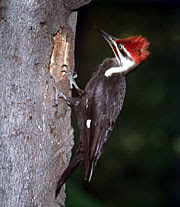
Even at 73, first experiences are possible. Some good things have happened already. For example, just last week, as I was walking around the block as a warm up for my home physical therapy exercises, I heard a steady, loud, hammering sound. Looking up to where the sound appeared to be originating, I spied a large, black, handsome bird crowned with a red comb banging his beak against a tree. My first glimpse of a pileated woodpecker; widespread across the norther part of the country but not often seen; here it is:
Indeed, a handsome bird, but my recall is that the beak was somewhat more pronounced. At any rate, he could really pound that tree! And big, at about 18 inches or 45 cm long.
Another first happened the other night. After a couple of days of really sultry weather, a severe thunderstorm alert, prompted me to go out to see if it was coming. My eyes were attracted downward to the lawn where there were hundreds of winking, bright pinpoints of white light...fireflies!!! Amazing. So far as I am aware, we do not have fireflies in Australia (but perhaps in caves) and I had not seen any in the Northwest. The next day, the barrista in the coffee shop told me that the folks down South, such as in Georgia, catch them and place them in jars to light the night, releasing them the next day.
Perhaps the secret of living, to a degree, is the art of 'finding firsts'; at the least, they certainly stir the blood. I think I may have a few ahead. Some of you know that I plan to return to Australia later this year to resume residence there. Yes, on September 18, I board the United Flight from San Francisco to return to the land of my birth, ending some 15 years of residence in the US. With good friends and family still here, of course, I will return from time to time. In the Gospels, Jesus remarked that it is 'easier for a camel to go through the eye of a needle than for a rich man to enter the Kingdom of God'. He was referring to the necessity, once the main gate of a walled city was closed at night, of bending low to pass through the 'eye gate'...quite a tight squeeze! So it will be for me; my possessions will have been reduced to what will fit into two suitcases. With less than what I had when I left in February of 1995, I will re-enter my home land.
In many ways, I expect this to be the beginning of a new life. To stay with the biblical metaphors, I will be 'born again', enduring the narrow passage of birth and stripped of all but a few possessions just as Jesus said, 'Except one is born again, one cannot see the kingdom of God'.
Jesus was referencing a universal law of the journey: to go somewhere, one must first accept the discipline of the way to be taken.
What will I do and where will I live in the land that awaits my discovery?
And what is this like for me? Quite exciting; I am minded of the words that Tennyson put into the mouth of Ulysses:
I cannot rest from travel,
I will drink life to the lees...
...
For always roaming with a hungry heart
Much have I seen and known...
...
I am part of all that I have met,
Yet all experience is an arch wherethro'
Gleams that far untravell'd world, whose margin fades
For ever and forever when I move.
How dull it is to pause, to make an end,
To rust unburnished, not to shine in use!
As tho' to breath were Life! Life piled on life
Were all to little, and of one to me
Little remains: but every hour is saved
From that eternal silence, something more,
A bringer of new things...
...
And this gray spirit, yearning in desire
To follow knowledge like a sinking star,
Beyond the utmost bound of human thought.
Ah well, a tall order; but why not give it shot?
Subscribe to:
Posts (Atom)

