WHAT IS IN A SUITCASE CAN SURPRISE YOU...even if you think you know what is inside. I love the story of how Ernest Hemingway, on returning to Paris after many years, entered the hotel where he had so often stayed. The manager, having made him welcome, inquired whether he would like to take possession of the suitcase he had left in storage there. Hemingway had forgotten all about the suitcase but had worried over the loss of all his notes made when, as a young man, he had lived in the Latin Quarter. On opening the suitcase, there they were! His earlier life once more revealed. These became the material for his book "A Moveable Feast".
I cannot claim such a momentous experience but when I opened my suitcase left at my sister's home containing a cache of Aussie summer clothes, I was overtaken by surprise. Suddenly I became the fellow who had packed that case, with all the feelings and thoughts that I had at that time, contemplating my return to the US! My passing through the eye of the needle was about to become a labyrinthine adventure.
You who have so faithfully followed these postings will recall that I had intended to return to live in Australia permanently but, on being here for some months, decided that I really wanted to live in the Corning area in upper New York state. I can tell you that I had lots of ideas of how that might be and, frankly, quite a deal of anxiety, not to mention a certain feeling of slight insanity about this sudden reversal.
As I surveyed the contents of that case I felt as if sucked back into a time vortex, falling through the seeming eons of change in my life since closing up that case, a brief experience akin to Alice falling down the rabbit hole. Lots of things have happened since then. Instead of building a little home for myself, I found a house just perfect for conversion into an ageing bachelor's abode with hardly a vestige of garden just waiting transformation. This story is continuing in my other Blog
I returned to the US, spent some time with my daughter in Colorado and then drove up through Glacier National Park to visit with friends first in Fort Langley BC, then in Seattle and Portland, before returning to Basalt CO. In Portland, Howard, my sometime counselor, led me to see how core to my being is traveling, a revelation to me but likely no news to you, my readers.
Then it was across a good part of the US, enjoying the first signs of Spring through the mid-western states and finally into New York state where I was welcomed by rain, rain, and more rain. Eventually I went as far as Chatham, almost to Massachusetts, to assist Richard and Gina a little with the renovations of their new home. I had little idea of the adventure I was about to embark on with my small home in Sterling Street, back in Corning.
There have been other adventures but central has been my quest for spirituality. I managed to sack the god of my early adulthood and to redefine for myself the nature of belief. A stout agnostic, tending atheist, I nevertheless faithfully attend the local Episcopal Church when at home and where I feel very much at home. I have rediscovered what it might be to be a follower of Jesus (now a very different figure compared with my early conceptions of him) and value the company of those who follow a similar course and also the connectedness I feel with those who have gone before, all the way back to his time and teachings. I am not much concerned with theology though its complexities, inconsistencies, and dilemmas I still find most interesting. I think that I am learning more than ever to respect the faith of others.
Emboldened by the suitcase experience, this last Sunday I ventured downtown (into Adelaide, the City of Churches) into Flinders Street, first of all to Holy Communion (8 AM) at Pilgrim Church. This is part of the Uniting Church (formerly Methodist, Congregational, and Presbyterian churches). I joined with 20 or so other followers of Jesus to remember the last meeting of Jesus with his followers, according to his request). The visiting speaker spoke of the partnership the Uniting Church has with other fellowships around the world, particularly in Bali where Christians are developing interfaith approaches to worship and combating the effects of global warming. Following the breaking of bread and the communal cup of remembrance, we all met for breakfast.
My next stop was Flinders Street Baptist Church for their 10AM worship meeting. In this church I was ordained to the Baptist pastoral ministry (July 31, 1964). Must have been all of 40 years since last in this place! At coffee and biscuits after, I met an amazing number of folk I had known back in those long gone days, some of whom I was hitherto sure would have since died! So, another suitcase opened with very pleasurable results.
Just goes to show, suitcase have their little surprises.
Sunday, October 30, 2011

Friday, October 28, 2011
ROBERTO DOWN UNDER.
MY LIFE HAS SETTLED INTO A PLEASANT ROUTINE. I manage to get in good walk each day, usually first thing after two cups of coffee, either along the cliff tops overlooking the sea (if at my sister's) or around the area where my daughter lives, if with her and her family. The bicycle has added a more demanding dimension, especially if at my sister's, as the hills thereabouts can be quite demanding. A 'to do' list is appearing as I survey the work yet to be done on her house. My daughter has a list too, but not so demanding so I can be more relaxed.
 The beach terminus, by the way, as at a seaside place called 'Glenelg', the only town name palin-drome of which I am aware.
One of the reasons she has visited is to lead the Commonwealth Heads of Government meeting, an auspicious event unlikely to be noticed by the non-Commonwealth world*. Sixteen nations make up the Queen's Realm', including the UK, Canada, and Australia; these have the Queen as their nominal head of government. There is a bunch of other countries in the Commonwealth of Nations, all united by their love of the game of cricket (with the exception of Canada, although it is played in British Columbia)
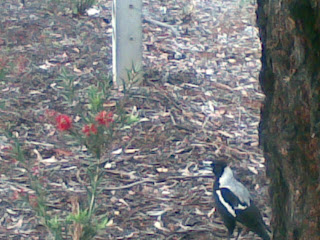
I though you might like this picture of the Aussie Magpie snapped while on my suburban walk, apparently studying a young Bottle Brush. This is alongside the light rail line that so conveniently runs close to where my daughter lives and then into downtown , or to the beach, depending on direction.
The beach terminus, by the way, as at a seaside place called 'Glenelg', the only town name palin-drome of which I am aware.The Queen has been down here also, at least her fourth visit to this land. She did not come to Adelaide thereby avoiding getting in my way...that she has done three times so far, once in Adelaide, once in Melbourne, and once in Brighton UK. "What's with all these crowds?", I have asked these three occasions. "Its the Queen, silly.", has come the reply.
One of the reasons she has visited is to lead the Commonwealth Heads of Government meeting, an auspicious event unlikely to be noticed by the non-Commonwealth world*. Sixteen nations make up the Queen's Realm', including the UK, Canada, and Australia; these have the Queen as their nominal head of government. There is a bunch of other countries in the Commonwealth of Nations, all united by their love of the game of cricket (with the exception of Canada, although it is played in British Columbia)
Australians are quite given over to gambling. Currently there is a move by the government to require poker machines to have players nominate the amount of money they are prepared to lose. Once they reach this amount, the machines will cease playing for them. Given the many tales of gambling induced tragedy, one could hardly fault such a move. Predictably, the gambling business is up in arms against this measure. One gambling magnate said that present measures are adequate to prevent abuse and that other more effective means could be devised. A statement likened by one commentator as similar to a well-known African dictator speaking for democracy!
Less controversial is the famous Melbourne Cup Day, the culmination of a several weeks of horse racing. Aussies do love the horses. Some are a little miffed that the Queen, herself a prominent owner of racing horses, is not hanging about for this event (although she is 'bouncing the ball' to start an Aussie Rules football match over in Perth before she departs...akin to the President pitching the first ball at a baseball game). What is remarkable is that, on the first Tuesday in November, the nation will virtually stop to listen to the broadcast commentary, or watch the televised race. In offices everywhere, there will be the 'Cup sweep" when hopefuls will contribute a dollar or two, maybe to take home small winnings. Well, one has to be in it to win it! Your name is attached to a horse's name drawn at random from a hat and you may be lucky enough to have scored the winner.
After 'The Cup', the nation will settle down back to normal.
Apart from Adelaide, that is. Here in a couple of weeks, the Great Christmas Pageant will occur. Colorful floats depicting fairy tales and Christmas stories will emerge, all spruced up, from storage and parade through the city streets. This is almost an international event, attracting many visitors from around the world, and many thousands of children and their proud parents, all lining the streets and awed by the procession. The last float will have on board good old jolly Father Christmas and a gang of helping gnomes and fairies. This will deliver the venerable gentleman to the Magic Cave in the basement of one of the large downtown stores (the event sponsor), thereby opening the way for all the other stores to produce their St. Nicholas clones. Finally, the Season of Joy will be resoundingly upon us.
How I loved this event when a child, growing up in this fair city. Now I avoid it (like the Queen).
The Queen, in her royal way, is quite the trooper, even likened by some to having rock-star quality. There is some agreement that her visit may have set back somewhat the occasional urge of Australians to become some sort of republic. This can only be determined by a nation-wide referendum, involving a majority of the people and at least half of the states. This may go on the back burner during the present Monarch's lifetime, or until she abdicates. Long live the Queen?
*I take that back...it did get a mention in the latest NY Times at least.
Saturday, October 22, 2011
NOW IN ADELAIDE, SOUTH AUSTRALIA
AS YOU MIGHT RECALL, I was last heard from in San Francisco airport, awaiting boarding for my flight to Sydney, somewhat dreading the coming ordeal. It turned out to be not so bad, as is the case with most things dreaded, and perhaps one of the better experiences I have had crossing the Pacific. Since I have now done this 30 or so times, this may be worth noting.
Apropos of how to avoid jet lag, this time I decided to sleep according to departure zone and eat according to arrival zone time. I had an aisle seat in the Exit row with plenty of leg room and that helped a lot too. Whatever the reason or reasons, not a trace of jet lag.
After a very long night (some 13 hours) we arrived in Sydney on time, about 7 AM local time. A short wait in the Transit Lounge and I boarded the United flight on to Melbourne. There I met up with my dear friend of some 30 years, Kim. We ate Thai and I say again that it is hard to beat Melbourne for excellent food. Then aboard the bus for the overnight trip to Adelaide. To complete the diversity of travel (plane, bus, BART, and walking), I ambled in the early morning hour to the central square of Adelaide to catch the light rail to my daughter's home (just across the parklands from Adelaide downtown), presenting myself at just on 7AM. H ow very nice to have arrived, at last!
Since then, I have gotten in lots of walking and have even purchased a cycle to ride when I am here each year (alas, Bike Friday remains in Corning; I hope not too upset at being left behind). This is a great season to be here, the weather very like that in San Francisco. Many natives bloom during the Winter and the wattle is still quite beautiful, though somewhat muted. This cannot be said of the birds, all as colorful and noisy as ever. With the warming of the weather, the lizards and skinks are eager to soak up the sun. Walking with the family yesterday, I spied a Blue Tongued lizard hogging his share who then quickly scuttled off into the safety of a nearby bush as we approached.
The Spring flowers are making their entrance and I am including a picture of one such along the bike path I use for my morning walk (commonly called, I think, the Bottle Brush). You will see why as you view this photo. Of course, you may never use a bottle brush but we oldies once did to clean out bottles. Very useful indeed!
So it is very pleasant to be back here for some six weeks. My little house awaits my return. Daniel, my contractor, will be finishing out the external trim on the sun/potting room, fixing up some leaks and removing the framework of the wall between the living room and the kitchen/breakfast room. With the temperatures falling during the Fall (what else can the temperature do in the Fall?), the house will be mainly closed up and the heating system set to run close to 60 deg. F. I will be very interested to see what the gas use will be during this period I am away. I expect to see six inches of snow when I return after Christmas.
Those cyclists among you will be interested to see what my cycle looks like. It is exactly the sort of bike I wanted for riding around hereabouts and cost about half of what I thought I might have to pay. The mechanic in the pic is Graham, formerly of Winnipeg, Canada. He does not miss the Winter there. It is a modest bike, with more gears/speeds than I expect to use and 'flat' handlebars. It is very comfortable, being quite well suited to my peculiar build.
Until next time. I probably will not say more about Adelaide. In the unlikely event that you might one day visit 'Down Under', I recommend to you my home city. A very relaxing place to be and well endowed with good food, wine, and places to go.
Apropos of how to avoid jet lag, this time I decided to sleep according to departure zone and eat according to arrival zone time. I had an aisle seat in the Exit row with plenty of leg room and that helped a lot too. Whatever the reason or reasons, not a trace of jet lag.
After a very long night (some 13 hours) we arrived in Sydney on time, about 7 AM local time. A short wait in the Transit Lounge and I boarded the United flight on to Melbourne. There I met up with my dear friend of some 30 years, Kim. We ate Thai and I say again that it is hard to beat Melbourne for excellent food. Then aboard the bus for the overnight trip to Adelaide. To complete the diversity of travel (plane, bus, BART, and walking), I ambled in the early morning hour to the central square of Adelaide to catch the light rail to my daughter's home (just across the parklands from Adelaide downtown), presenting myself at just on 7AM. H
 ow very nice to have arrived, at last!
Since then, I have gotten in lots of walking and have even purchased a cycle to ride when I am here each year (alas, Bike Friday remains in Corning; I hope not too upset at being left behind). This is a great season to be here, the weather very like that in San Francisco. Many natives bloom during the Winter and the wattle is still quite beautiful, though somewhat muted. This cannot be said of the birds, all as colorful and noisy as ever. With the warming of the weather, the lizards and skinks are eager to soak up the sun. Walking with the family yesterday, I spied a Blue Tongued lizard hogging his share who then quickly scuttled off into the safety of a nearby bush as we approached.

The Spring flowers are making their entrance and I am including a picture of one such along the bike path I use for my morning walk (commonly called, I think, the Bottle Brush). You will see why as you view this photo. Of course, you may never use a bottle brush but we oldies once did to clean out bottles. Very useful indeed!
So it is very pleasant to be back here for some six weeks. My little house awaits my return. Daniel, my contractor, will be finishing out the external trim on the sun/potting room, fixing up some leaks and removing the framework of the wall between the living room and the kitchen/breakfast room. With the temperatures falling during the Fall (what else can the temperature do in the Fall?), the house will be mainly closed up and the heating system set to run close to 60 deg. F. I will be very interested to see what the gas use will be during this period I am away. I expect to see six inches of snow when I return after Christmas.
Those cyclists among you will be interested to see what my cycle looks like. It is exactly the sort of bike I wanted for riding around hereabouts and cost about half of what I thought I might have to pay. The mechanic in the pic is Graham, formerly of Winnipeg, Canada.
 He does not miss the Winter there. It is a modest bike, with more gears/speeds than I expect to use and 'flat' handlebars. It is very comfortable, being quite well suited to my peculiar build.
Until next time. I probably will not say more about Adelaide. In the unlikely event that you might one day visit 'Down Under', I recommend to you my home city. A very relaxing place to be and well endowed with good food, wine, and places to go.
Monday, October 10, 2011
ONLY IN AMERICA
SORRY FOLKS... you will have to wait a bit longer of a final 'god' posting but some things are going on I need to reflect on with you. As for the no doubt long awaited note of possible implications on of choosing Mother Earth, imagine that it were She who spoke to Moses out of the burning bush or on Mt Horeb, what might the Ten Commandments have said?
In a week or so, I will be back in Australia for almost two months which will certainly be a change of scene, not the least entering Spring and then a taste of Summer. Now prepare for a slight jump.
Just last week I attended the annual presentation of the Medicare Advantage fund I have chosen. A bunch of us seniors gathered at a local, very spiffy, motel to hear the good news and the bad news about our 2012 cover and costs to us. No need to go into the boring detail of this except to say that I found myself reflecting that, under Medicare in Australia, there would never be a reason to go to such a meeting, nor would I be getting monthly summaries from such an organization. All needless under 'socialized medicine'. I would, of course,be comforted for any possible sense of loss by the knowledge that far less money would be spent on administration and therefore available for actual services. I did ask a question about cover while out of state and this betrayed that I am from Australia, a far away and mysterious country hereabouts.
Now here comes the jump I mentioned: a woman came up to me after the meeting to say that she had heard that Australia is a very prejudiced country. Hmm, I thought to myself, this is news to me, given that there are about 200 different language groups and almost half of the inhabitants born somewhere else and all getting on fairly well.
After several questions, it became clearer that she was thinking about intolerance toward religion and particularly directed at Christianity. Now this was really news to me but I managed to keep my peace. Walking back to my car, I reflected that there is something really 'nutty' about some folks views on religion and the role it ought to play in this society. Forget that Jesus once said, 'Render to Caesar what belongs to Caesar, and to God what belongs to God.'
Consider that the country may be in much the same trouble as before the Great Depression of the 1930s but, instead of pulling together in a time of crisis, proper government has been traduced by devastating political partisanship. The political right looks to be taken over by christian fundamentalists, some of them claiming to be 'new apostles', while the current paramount political anxiety seems focused on that a looming serious candidate for the presidency is a member of the Church of Jesus Christ and Latter Day Saints ( a Mormon)!
As the saying goes...Give me a break! Unattended to is the greater divide by wealth. Millions are out of work, 15% of the population are in poverty, homelessness even of some who were once middle class is increasing, some 46 million are without health insurance, and most of us now know that 40% of the wealth is owned by 1% of the population, while only 15% is owned by 80%. Over 20% of high-school graduates cannot get work. Meanwhile, four of five members of Congress are millionaires. Once elected, members can expect generous health care and comfortable retirement benefits for the rest of their lives. Nonetheless many freely talk of reducing the costs of benefits for the poor and for seniors to 'balance the budget'. And so it goes...gone is the 'American Dream'; work hard and you might become rich, or at least enjoy the 'good life'.
A new development is the move to 'Occupy Wall Street". This began with young people but many older disenchanted middle class folk, and more recently the Labor Unions, are joining this movement. It is spreading to other cites, even my old home town of Portland, Oregon (Occupy Portland). The chant is, 'We are the 99%'. A growing number of folk sense that they have lost influence over government, that it has become 'government by the wealthy for the wealthy'. Some sense that, here in the US, home of the 'greatest democracy', some form of revolution is imminent. Around the world, young people, armed with iPods and immersed in Twitter, have emerged as a powerful revolutionary force.
Occupy Wall Street has been disparaged as 'aimless' and 'disorganized'. A somewhat radial Australian website (Citizen's Electoral Council) has acquainted me this is not the case. This movement is demanding return to the provisions of the Glass-Steagall Act passed in 1933. This regulated the banks to separate ordinary, commercial banking from investment banking and came about to restore order to the collapsed banking system here in the USA. Prior to this, bankers could do pretty much anything they wanted. This legislation was repealed in 1999 by the Republican dominated Senate and House of Representatives, signed into law by President (then just recently become a millionaire), and setting the stage for the 2007/2008 financial collapse here in the US which continues to affect global economy. Basically, the repeal turned the clock back to the pre-Great Depression era of unbridled financial license.
I doubt that the 99% are overly concerned about a Mormon possibly being in the White House. After all, we survived the election of a Roman Catholic and more recently the election a non-Caucasian. If the sky is falling, race and religion have little, if anything at all, to do with our current woes. Mormons, so far as I have been able to see, are honest, conscientious, moral, hardworking and trustworthy folk, at least as much as any other group given to faith. This could be seen by some as a breath of fresh air at the pinnacle of politics! This quip aside, I prefer to wait and see how things turn out.
What is the 'so what' of all this? Like folk the world around, Americans want to feel that the government is for the common weal. There are many who, as do I, don't want politicians who seem to pander to 'Wall Street', who are overly influenced by lobbyists (whether representing the drug companies, the health industry, the energy industry, the military related industries, the rifle associations and gun lobbies, the wealthy corporations, the labor unions, or religious groups). As the common Aussie phrase has it, just give us all a 'fair go'.
I suppose and hope that those increasing number chanting in the streets, 'We are the 99%', might finally get the politicians to listen to what once was the 'silent majority'.
In a week or so, I will be back in Australia for almost two months which will certainly be a change of scene, not the least entering Spring and then a taste of Summer. Now prepare for a slight jump.
Just last week I attended the annual presentation of the Medicare Advantage fund I have chosen. A bunch of us seniors gathered at a local, very spiffy, motel to hear the good news and the bad news about our 2012 cover and costs to us. No need to go into the boring detail of this except to say that I found myself reflecting that, under Medicare in Australia, there would never be a reason to go to such a meeting, nor would I be getting monthly summaries from such an organization. All needless under 'socialized medicine'. I would, of course,be comforted for any possible sense of loss by the knowledge that far less money would be spent on administration and therefore available for actual services. I did ask a question about cover while out of state and this betrayed that I am from Australia, a far away and mysterious country hereabouts.
Now here comes the jump I mentioned: a woman came up to me after the meeting to say that she had heard that Australia is a very prejudiced country. Hmm, I thought to myself, this is news to me, given that there are about 200 different language groups and almost half of the inhabitants born somewhere else and all getting on fairly well.
After several questions, it became clearer that she was thinking about intolerance toward religion and particularly directed at Christianity. Now this was really news to me but I managed to keep my peace. Walking back to my car, I reflected that there is something really 'nutty' about some folks views on religion and the role it ought to play in this society. Forget that Jesus once said, 'Render to Caesar what belongs to Caesar, and to God what belongs to God.'
Consider that the country may be in much the same trouble as before the Great Depression of the 1930s but, instead of pulling together in a time of crisis, proper government has been traduced by devastating political partisanship. The political right looks to be taken over by christian fundamentalists, some of them claiming to be 'new apostles', while the current paramount political anxiety seems focused on that a looming serious candidate for the presidency is a member of the Church of Jesus Christ and Latter Day Saints ( a Mormon)!
As the saying goes...Give me a break! Unattended to is the greater divide by wealth. Millions are out of work, 15% of the population are in poverty, homelessness even of some who were once middle class is increasing, some 46 million are without health insurance, and most of us now know that 40% of the wealth is owned by 1% of the population, while only 15% is owned by 80%. Over 20% of high-school graduates cannot get work. Meanwhile, four of five members of Congress are millionaires. Once elected, members can expect generous health care and comfortable retirement benefits for the rest of their lives. Nonetheless many freely talk of reducing the costs of benefits for the poor and for seniors to 'balance the budget'. And so it goes...gone is the 'American Dream'; work hard and you might become rich, or at least enjoy the 'good life'.
A new development is the move to 'Occupy Wall Street". This began with young people but many older disenchanted middle class folk, and more recently the Labor Unions, are joining this movement. It is spreading to other cites, even my old home town of Portland, Oregon (Occupy Portland). The chant is, 'We are the 99%'. A growing number of folk sense that they have lost influence over government, that it has become 'government by the wealthy for the wealthy'. Some sense that, here in the US, home of the 'greatest democracy', some form of revolution is imminent. Around the world, young people, armed with iPods and immersed in Twitter, have emerged as a powerful revolutionary force.
Occupy Wall Street has been disparaged as 'aimless' and 'disorganized'. A somewhat radial Australian website (Citizen's Electoral Council) has acquainted me this is not the case. This movement is demanding return to the provisions of the Glass-Steagall Act passed in 1933. This regulated the banks to separate ordinary, commercial banking from investment banking and came about to restore order to the collapsed banking system here in the USA. Prior to this, bankers could do pretty much anything they wanted. This legislation was repealed in 1999 by the Republican dominated Senate and House of Representatives, signed into law by President (then just recently become a millionaire), and setting the stage for the 2007/2008 financial collapse here in the US which continues to affect global economy. Basically, the repeal turned the clock back to the pre-Great Depression era of unbridled financial license.
I doubt that the 99% are overly concerned about a Mormon possibly being in the White House. After all, we survived the election of a Roman Catholic and more recently the election a non-Caucasian. If the sky is falling, race and religion have little, if anything at all, to do with our current woes. Mormons, so far as I have been able to see, are honest, conscientious, moral, hardworking and trustworthy folk, at least as much as any other group given to faith. This could be seen by some as a breath of fresh air at the pinnacle of politics! This quip aside, I prefer to wait and see how things turn out.
What is the 'so what' of all this? Like folk the world around, Americans want to feel that the government is for the common weal. There are many who, as do I, don't want politicians who seem to pander to 'Wall Street', who are overly influenced by lobbyists (whether representing the drug companies, the health industry, the energy industry, the military related industries, the rifle associations and gun lobbies, the wealthy corporations, the labor unions, or religious groups). As the common Aussie phrase has it, just give us all a 'fair go'.
I suppose and hope that those increasing number chanting in the streets, 'We are the 99%', might finally get the politicians to listen to what once was the 'silent majority'.
Thursday, September 22, 2011
TOMORROWS' GOD, TODAY?
A VEXING ASPECT OF BELIEF IN GOD is that, more often that not, our preference is to make this an ISSUE OF FACT. Suppose that this were just a matter of choice. On the one hand, you choose for a variety of reasons, to believe in God (as a factual being) and I, on the other and for another set of reasons, choose not to. This is just a matter of a difference of opinion. Each opinion seems as likely to be equally useful. Atheists, agnostics, and other non-theists are as likely to act morally, or immorally, and to have a sense of meaning and direction as those that hold to belief in God.
The unfortunate question is not, "Do you or do you not believe in a god, or gods?", but rather,"Is there or is there not a god, or gods?'. I have followed a course of thinking that this question does not occur spontaneously to us during the critical early years of life when we are internalizing representations of our physical selves within the physical world. Once we have acquired language we begin to encounter the much more complex world of culture and knowledge. Here we discover the musings of our culture, including whether the physical universe may be a consequence of some 'god', or supernatural being, active within or outside of it.
Christianity, and related religious views, has preserved the notion of a two level universe, the one where we live and the other where 'god' has always been and still is ('as it was in the beginning, is now, and shall be evermore'). This leads to quite a bit of mischief. Just before the beginning of the current era, an Epicurean thinker called Lucretius advanced the view that atoms comprise the world, including ourselves, and that this world is the only world (no other world where god or gods may be, and no 'next world' awaiting us after death). Lucretius was regarded by the Church as an atheist and anti-religionist. His book, 'On the Nature of Things', was suppressed by the Church and lost from the Third until the early Fifteenth Century when the only known remaining copy was discovered in an isolated monastery by a lover of old books .
The ideas of Lucretius presaged modern cosmologies based on the work of science on the nature of the substance of things. Now we see that we truly are made out of 'star dust', that the complex and amazing phenomenon of life has emerged naturally from this physical foundation, and that the soul or spirit of human kind resides only in our bodies as a consequence of our taking in the knowledge and beliefs of the culture into which we are born. This is courtesy of the workings of our fantastically complex brains and the equally amazing facility of human language, itself the foundation of thought and self-awareness.
What am I to do with this appreciation? I have no idea of what was the case before the 'Big Bang', when in the blink of an eye or less, our current world exploded into being. Perhaps 'god' was there; maybe this world of ours is fleeting phantasmagoria in the dreams of such a being. I will never know. It seems to me that, so far as we humans are concerned, the universe we know has become aware of itself through the rise of our intelligence. If a useful concept of god is to arise, it must as ever be our invention. Man creates 'god', not 'god' created man.
For myself, I embrace Mother Earth as my 'god'. I am dust of Her dust and to Her dust I will return. This is a view that cannot lead to much mischief, except by the 'sins' of omission.
Now, how to make sense of this leap of faith?
The unfortunate question is not, "Do you or do you not believe in a god, or gods?", but rather,"Is there or is there not a god, or gods?'. I have followed a course of thinking that this question does not occur spontaneously to us during the critical early years of life when we are internalizing representations of our physical selves within the physical world. Once we have acquired language we begin to encounter the much more complex world of culture and knowledge. Here we discover the musings of our culture, including whether the physical universe may be a consequence of some 'god', or supernatural being, active within or outside of it.
Christianity, and related religious views, has preserved the notion of a two level universe, the one where we live and the other where 'god' has always been and still is ('as it was in the beginning, is now, and shall be evermore'). This leads to quite a bit of mischief. Just before the beginning of the current era, an Epicurean thinker called Lucretius advanced the view that atoms comprise the world, including ourselves, and that this world is the only world (no other world where god or gods may be, and no 'next world' awaiting us after death). Lucretius was regarded by the Church as an atheist and anti-religionist. His book, 'On the Nature of Things', was suppressed by the Church and lost from the Third until the early Fifteenth Century when the only known remaining copy was discovered in an isolated monastery by a lover of old books .
The ideas of Lucretius presaged modern cosmologies based on the work of science on the nature of the substance of things. Now we see that we truly are made out of 'star dust', that the complex and amazing phenomenon of life has emerged naturally from this physical foundation, and that the soul or spirit of human kind resides only in our bodies as a consequence of our taking in the knowledge and beliefs of the culture into which we are born. This is courtesy of the workings of our fantastically complex brains and the equally amazing facility of human language, itself the foundation of thought and self-awareness.
What am I to do with this appreciation? I have no idea of what was the case before the 'Big Bang', when in the blink of an eye or less, our current world exploded into being. Perhaps 'god' was there; maybe this world of ours is fleeting phantasmagoria in the dreams of such a being. I will never know. It seems to me that, so far as we humans are concerned, the universe we know has become aware of itself through the rise of our intelligence. If a useful concept of god is to arise, it must as ever be our invention. Man creates 'god', not 'god' created man.
For myself, I embrace Mother Earth as my 'god'. I am dust of Her dust and to Her dust I will return. This is a view that cannot lead to much mischief, except by the 'sins' of omission.
Now, how to make sense of this leap of faith?
Friday, August 5, 2011
TOMORROW'S GOD?
THE CHIEF BUSINESS OF RELIGION is to provide meaning and a means of ordering life according to valued ideals . We understand a person's religion by observing how they live. As we have seen, the original and fundamental meaning of the word 'religion' refers to the ordering of actions according to cherished values and ideas. We may fall short of these values from time to time but, as religious persons, we keep returning to them. The concept of 'god' may or may not assist in this search.
It is also true that the concept of 'god', as we trace it in the long human story, has been central in our search for meaning. This need to understand the meaning of life seems to be built into us. Almost as soon as a child acquires language we begin to hear questions like,
'Who am I?'
'How did I get here?
'How did this world around me get to be?'
The child is not the first to ask such questions. Human kind has been asking them for eons. Culture stands ready to assist us with answers. At convent school, my catechism class informed me that God made me, and the world, for his glory.
From ancient stories and from the living fossils of the beliefs and stories of original humans, such as the Australian aborigine, the Inuit peoples, and native American tribes people, we may conclude that the world they experienced they understood to be moved from behind, as it were, by supernatural forces. These eventually became personalized as powerful ancient creatures, or as gods. In those days, we learned to accommodate to the wishes of these forces through rituals, perhaps hoping also we could influence events that were powerful and utterly mysterious. These rituals and the beliefs were central to life and rigorously guarded.
Another profound aspect of early human life appears to be that we then saw ourselves as part and parcel of the world around us. We came from the earth, were of the earth, and returned to the earth. Man and nature were the same, as with every living thing.
About three thousand years ago, as agriculture freed a class of thinkers to reflect more on the nature of the world, the notion of many gods that could be placated by rituals began to be 'pooh poohed' . The prophets of the Old Testament and the Greek philosophers even poked fun at these ideas. Buddha likewise argued their irrelevance. An enduring outcome of this radical thinking was the rise of monotheism, that there is just one 'god'. Associated with this was the loss of feminine attributes from the notion of 'god' and the tendency to move the concept of the deity out of nature to 'another' level of being. Likewise, man became removed from nature and began to be cast as created to have dominion over other animals and nature generally.
If you wish to follow this development, there are many sources but the writings of Lloyd Geering (the title of whose book, Tomorrow's God, I have borrowed to lead this posting) can get you started.
Western Christianity, heavily influenced by Paul (whom many regard as the founder of Christianity and a profoundly Greek Jew) absorbed and promoted a form of monotheism along with the dualistic view of nature vs. man and 'God'. It is ironic that Paul who, on his own confession, never met Jesus or heard him teach, paid scant attention to the teachings of Jesus but preferred to concentrate on the death and resurrection of Jesus and through this the notion of the creation of a 'New Israel' in the life of the churches he influenced. Though Paul may be special case, because of his wide influence, it is very probable that none of the writers who contributed to what we now call the 'New Testament', had met or heard Jesus. The same can be said, but more forcibly, of all who have written about Christianity since.
The other monotheistic faiths, Judaism and later Islam, have followed a similar course, masculating the deity, separating the domain of the deity from the earth and nature, and casting humankind as the center of the universe and the chosen master of nature.
But wait...in the last two hundred years another world view has emerged. The stuff of life is also the stuff of the universe. Elements that make my biochemistry possible, that make me work as I type this posting, were manufactured only lately in the life of the universe, in the collapse and explosions of fourth generation stars, blasted across eons and finally collected here in our planet, Earth. Scientists, delving laboriously into the nature of things, tell me that matter is not what I think it to be but continuously disappears and reappears, and that the 'vacuum' of space is full of energy and stuff the like of which I will never understand. Meanwhile the biologists, delving into the DNA that has driven my own personal development from conception, contains the DNA of bacteria that may have been the first forms of life, and then of primitive plants, and all manner of creatures that have come and gone in the generations of life on this planet.
So, in a fundamental sense, the wheel of meaning has turned an entire circle, back to where we are beginning to see that human kind, and all kind, are part and parcel of the earth, coextensive and one with the universe, a concatenation or merging once more of the secular and the sacred. However, this cannot support the notion of a 'god' who is 'up above', or 'out there' in a higher level of being.Now we may see how we differ from our ancestral seekers of meaning.
It is also true that the concept of 'god', as we trace it in the long human story, has been central in our search for meaning. This need to understand the meaning of life seems to be built into us. Almost as soon as a child acquires language we begin to hear questions like,
'Who am I?'
'How did I get here?
'How did this world around me get to be?'
The child is not the first to ask such questions. Human kind has been asking them for eons. Culture stands ready to assist us with answers. At convent school, my catechism class informed me that God made me, and the world, for his glory.
From ancient stories and from the living fossils of the beliefs and stories of original humans, such as the Australian aborigine, the Inuit peoples, and native American tribes people, we may conclude that the world they experienced they understood to be moved from behind, as it were, by supernatural forces. These eventually became personalized as powerful ancient creatures, or as gods. In those days, we learned to accommodate to the wishes of these forces through rituals, perhaps hoping also we could influence events that were powerful and utterly mysterious. These rituals and the beliefs were central to life and rigorously guarded.
Another profound aspect of early human life appears to be that we then saw ourselves as part and parcel of the world around us. We came from the earth, were of the earth, and returned to the earth. Man and nature were the same, as with every living thing.
About three thousand years ago, as agriculture freed a class of thinkers to reflect more on the nature of the world, the notion of many gods that could be placated by rituals began to be 'pooh poohed' . The prophets of the Old Testament and the Greek philosophers even poked fun at these ideas. Buddha likewise argued their irrelevance. An enduring outcome of this radical thinking was the rise of monotheism, that there is just one 'god'. Associated with this was the loss of feminine attributes from the notion of 'god' and the tendency to move the concept of the deity out of nature to 'another' level of being. Likewise, man became removed from nature and began to be cast as created to have dominion over other animals and nature generally.
If you wish to follow this development, there are many sources but the writings of Lloyd Geering (the title of whose book, Tomorrow's God, I have borrowed to lead this posting) can get you started.
Western Christianity, heavily influenced by Paul (whom many regard as the founder of Christianity and a profoundly Greek Jew) absorbed and promoted a form of monotheism along with the dualistic view of nature vs. man and 'God'. It is ironic that Paul who, on his own confession, never met Jesus or heard him teach, paid scant attention to the teachings of Jesus but preferred to concentrate on the death and resurrection of Jesus and through this the notion of the creation of a 'New Israel' in the life of the churches he influenced. Though Paul may be special case, because of his wide influence, it is very probable that none of the writers who contributed to what we now call the 'New Testament', had met or heard Jesus. The same can be said, but more forcibly, of all who have written about Christianity since.
The other monotheistic faiths, Judaism and later Islam, have followed a similar course, masculating the deity, separating the domain of the deity from the earth and nature, and casting humankind as the center of the universe and the chosen master of nature.
But wait...in the last two hundred years another world view has emerged. The stuff of life is also the stuff of the universe. Elements that make my biochemistry possible, that make me work as I type this posting, were manufactured only lately in the life of the universe, in the collapse and explosions of fourth generation stars, blasted across eons and finally collected here in our planet, Earth. Scientists, delving laboriously into the nature of things, tell me that matter is not what I think it to be but continuously disappears and reappears, and that the 'vacuum' of space is full of energy and stuff the like of which I will never understand. Meanwhile the biologists, delving into the DNA that has driven my own personal development from conception, contains the DNA of bacteria that may have been the first forms of life, and then of primitive plants, and all manner of creatures that have come and gone in the generations of life on this planet.
So, in a fundamental sense, the wheel of meaning has turned an entire circle, back to where we are beginning to see that human kind, and all kind, are part and parcel of the earth, coextensive and one with the universe, a concatenation or merging once more of the secular and the sacred. However, this cannot support the notion of a 'god' who is 'up above', or 'out there' in a higher level of being.Now we may see how we differ from our ancestral seekers of meaning.
Saturday, July 30, 2011
PLAYING WITH DYNAMITE
A QUITE HAIR RAISING TIME in my life came about when my family moved from the quiet town of Clare (in the mid-North of South Australia) down to the outskirts of Adelaide (the capital city of South Australia). I must have been around nine or ten years (a long time ago!). On a clear day, one could just see the 'tall' buildings of the city in the distance. The suburb was called 'Northfield'.
The first 'scary' thing was that I now had to go to the one-teacher school just across the road. Having attended convent school where only the nuns taught, this was very different and formidable. I feigned sick for three days until my mother took me across. It did not help that the teacher was called Mr. Basham (aka, Bash 'Em?). As with many things that initially frighten, this turned out to be an unexpectedly enriching experience.
What was really frightening was the local gang of boys, some of whom were already attending high-school and learning science. These local lads were fond of making knives, slingshots, and fireworks (having learned to make gunpowder) and loved to get into adventures around the local quarries. Some adventures were really hair raising. Had they know of them, our parents would have clamped down on our freedom; we, however, kept 'Mum'.
The leaders of our local lads had learned to pick the lock on the explosives store at the quarry. From this we occasional 'borrowed' sticks of gelignite, fuse, and detonators. What a time we had, blowing up rabbit warrens, fence posts, and impressing the girls, when we all went skinny-dipping down at a disused quarry filled with water, by throwing a quarter stick, fuse sizzling, into the deepest parts, enormous aquatic eruptions resulting. Ah, those were the days! I think it was then that I began to gain a respect for life and the wisdom of carefully graduating risk.
The Swedish industrialist Alfred Nobel invented the Nobel patent detonator used with dynamite and nitroglycerin. Dynamite, or gelignite, consists of nitroglycerin mixed with clay which makes it safe to handle (a slight shock can set off nitroglycerin) which then needed a device to set it off reliably. As the dynamite king, he became very rich and remains famous and influential due to the Nobel Prize.
Can I hear you saying, "What has this to do with belief in 'God'?" A seemingly tenuous connection, I do admit. On the other hand, it makes for an attention getting beginning to this post. Perhaps toying with the notion of 'God' may appear a little like playing with dynamite. Our word, 'dynamite', comes directly from the Greek, 'dunamis', meaning power. Actually, 'elemental power'...the kind of power seen in the tempest, the whirlwind, tornado or hurricane, volcanic eruptions and earthquake, events that the ancients attributed to 'god'. Even today, we sometimes refer to these as 'acts of God'.
What I have been leading up to is that the ancients got it back to front. They concluded that 'god' or 'gods' were behind such events. As with the air they breathed so also the language they used. They came to speak of 'gods' and 'god' because they could speak.
Language has been with us for so long that we know little of how it became invented or even how, once created by man, it developed. But invented it was and is now so much a part of our nature that we are hardly aware of it and how profoundly this invention has influenced human development. It has been conjectured that language is coupled to increasingly efficiency of our evolutionary forebears as hunters. More dietary meat supported increased brain development (less gut needed, more brain possible within the range of possible energy intake). More brain supported more language capacity, while better communication through language led to better hunting and foraging, to a more versatile omnivorous diet, and so on. Efficient food gathering in turn mean more time for sitting around and just talking, and the invention of stories and so, the rise of culture and art, each an enormous expansion of the range of the individual mind.
Whatever...in reality, I conclude, man made god, through language, thinking, and wondering about the nature of things. We may say the 'God' made man (and the world), but this does not make it so. What does it mean to say, 'in reality'? I refer to the representation of the world that is in our heads, and in our culture, that has been painstakingly constructed over time and into which we have grown since birth.
It might well be extremely distressing to dismiss 'god' in this way. On the other hand it may also be abundantly creative. If the concept of 'god' is something within our control, maybe we can now do a proper job of work on it. There are pressing reasons why it would be of inestimable value to human kind to get on with this.
In his Large Catechism, Martin Luther defined 'god' as 'that to which we look for all good and where we resort in every time of need; to have a god is simply to trust and believe in one with our whole heart'. Here he is using the original notion of 'belief' which is to entrust oneself, or commit to a most highly valued course (as distinct from the modern use relating to assenting to a point of view).
As a former Augustinian monastic, and a leader of the Protestant Reformation, Luther was confident that a study of Holy Scripture would be the key to finding or fixing on the True God. Nowadays, it is possible to see that the Bible is a collection of stories of human origin, useful for guiding us in living but not conclusive when it comes to understanding the world. Moreover, I have suggested that it contains a view of reality, preserved by traditional Christianity, that is turning out to be dangerous to the world and our life on it.
An earlier monastic, a Franciscan, William of Ockam (try Googling 'Occam's Razor) proposed that the simplest explanation of anything should be preferred. Eventually this view, coupled with the overthrow of the authority of the Church, led to the scientific understanding of the world we now enjoy and the emergence of the modern secular world view. By holding onto the dualism implicit in traditional theological interpretations, broad Christianity has fallen behind, along with Islam and Judaism, in assisting human kind to find the faith needed for the challenges of the modern age.
If, instead, we turned to what we have come to know of the world, what manner of 'god' might we invent, to which we could entrust ourselves in our time of need?
The first 'scary' thing was that I now had to go to the one-teacher school just across the road. Having attended convent school where only the nuns taught, this was very different and formidable. I feigned sick for three days until my mother took me across. It did not help that the teacher was called Mr. Basham (aka, Bash 'Em?). As with many things that initially frighten, this turned out to be an unexpectedly enriching experience.
What was really frightening was the local gang of boys, some of whom were already attending high-school and learning science. These local lads were fond of making knives, slingshots, and fireworks (having learned to make gunpowder) and loved to get into adventures around the local quarries. Some adventures were really hair raising. Had they know of them, our parents would have clamped down on our freedom; we, however, kept 'Mum'.
The leaders of our local lads had learned to pick the lock on the explosives store at the quarry. From this we occasional 'borrowed' sticks of gelignite, fuse, and detonators. What a time we had, blowing up rabbit warrens, fence posts, and impressing the girls, when we all went skinny-dipping down at a disused quarry filled with water, by throwing a quarter stick, fuse sizzling, into the deepest parts, enormous aquatic eruptions resulting. Ah, those were the days! I think it was then that I began to gain a respect for life and the wisdom of carefully graduating risk.
The Swedish industrialist Alfred Nobel invented the Nobel patent detonator used with dynamite and nitroglycerin. Dynamite, or gelignite, consists of nitroglycerin mixed with clay which makes it safe to handle (a slight shock can set off nitroglycerin) which then needed a device to set it off reliably. As the dynamite king, he became very rich and remains famous and influential due to the Nobel Prize.
Can I hear you saying, "What has this to do with belief in 'God'?" A seemingly tenuous connection, I do admit. On the other hand, it makes for an attention getting beginning to this post. Perhaps toying with the notion of 'God' may appear a little like playing with dynamite. Our word, 'dynamite', comes directly from the Greek, 'dunamis', meaning power. Actually, 'elemental power'...the kind of power seen in the tempest, the whirlwind, tornado or hurricane, volcanic eruptions and earthquake, events that the ancients attributed to 'god'. Even today, we sometimes refer to these as 'acts of God'.
What I have been leading up to is that the ancients got it back to front. They concluded that 'god' or 'gods' were behind such events. As with the air they breathed so also the language they used. They came to speak of 'gods' and 'god' because they could speak.
Language has been with us for so long that we know little of how it became invented or even how, once created by man, it developed. But invented it was and is now so much a part of our nature that we are hardly aware of it and how profoundly this invention has influenced human development. It has been conjectured that language is coupled to increasingly efficiency of our evolutionary forebears as hunters. More dietary meat supported increased brain development (less gut needed, more brain possible within the range of possible energy intake). More brain supported more language capacity, while better communication through language led to better hunting and foraging, to a more versatile omnivorous diet, and so on. Efficient food gathering in turn mean more time for sitting around and just talking, and the invention of stories and so, the rise of culture and art, each an enormous expansion of the range of the individual mind.
Whatever...in reality, I conclude, man made god, through language, thinking, and wondering about the nature of things. We may say the 'God' made man (and the world), but this does not make it so. What does it mean to say, 'in reality'? I refer to the representation of the world that is in our heads, and in our culture, that has been painstakingly constructed over time and into which we have grown since birth.
It might well be extremely distressing to dismiss 'god' in this way. On the other hand it may also be abundantly creative. If the concept of 'god' is something within our control, maybe we can now do a proper job of work on it. There are pressing reasons why it would be of inestimable value to human kind to get on with this.
In his Large Catechism, Martin Luther defined 'god' as 'that to which we look for all good and where we resort in every time of need; to have a god is simply to trust and believe in one with our whole heart'. Here he is using the original notion of 'belief' which is to entrust oneself, or commit to a most highly valued course (as distinct from the modern use relating to assenting to a point of view).
As a former Augustinian monastic, and a leader of the Protestant Reformation, Luther was confident that a study of Holy Scripture would be the key to finding or fixing on the True God. Nowadays, it is possible to see that the Bible is a collection of stories of human origin, useful for guiding us in living but not conclusive when it comes to understanding the world. Moreover, I have suggested that it contains a view of reality, preserved by traditional Christianity, that is turning out to be dangerous to the world and our life on it.
An earlier monastic, a Franciscan, William of Ockam (try Googling 'Occam's Razor) proposed that the simplest explanation of anything should be preferred. Eventually this view, coupled with the overthrow of the authority of the Church, led to the scientific understanding of the world we now enjoy and the emergence of the modern secular world view. By holding onto the dualism implicit in traditional theological interpretations, broad Christianity has fallen behind, along with Islam and Judaism, in assisting human kind to find the faith needed for the challenges of the modern age.
If, instead, we turned to what we have come to know of the world, what manner of 'god' might we invent, to which we could entrust ourselves in our time of need?
Subscribe to:
Posts (Atom)


