G&D LOOK LIKE BEING ALL AROUND US for some while to come...so how about a little more of Paris? This post is about food...
A funny thing happened the last evening we were in Paris. After spending a pleasant late afternoon in the Luxembourg Gardens, we walked back to our hotel to shower and dress up a little for the next big event: dinner at the corner bistro. Uma was determined to have the steak with pepper sauce I had sampled a day or so earlier. I settled on the breast of chicken. An interesting feature of the menu is that it had little footnotes about areas from which the meats originate; four areas not too far from Paris. Now...this is not an expensive restaurant, just your ordinary local cafe-bar bistro. Well, you say, 'What is funny about that?' OK, I am getting to that... but I bet it would be hard to find such footnotes on the menus of the cafes where you and I ordinarily eat.
The funny thing was the taste of the chicken. It tasted quite a bit like the 'chook' I used to eat back in days before supermarkets. Explanation needed here...the term 'chook' is Australian vernacular for fowl. As a boy, my family ran chooks in the back yard as quite a few folk still do if the local regulations permit. The chooks forage all about and do a great job of keeping local insect populations low. They also gobble up kitchen scraps and grain you spread about in the evenings. In the morning, you go and collect the eggs. When they ceased laying or happened to have become to be a supernumerary rooster, they were killed off and became a feature of Sunday lunch. For a special occasion, if you didn't run chooks or wanted to preserve your layers, you could buy one at the local butcher shop who might also have a rabbit or two for sale as well as the usual range of meats.
The curious thing is: the chicken you buy in the supermarket tastes nothing like those free ranging chooks. I was eating some last night, come to think of it, and it is hard to say just what it tastes like; certainly not like good old fashioned 'chook'.
I confess it was a bit of a shock to rediscover what chicken used to taste like...kind of 'wild'. Now I think of it, the french fries tasted a little strange too; they had a distinct 'potato' flavor! The French of course, above all else, are 'foodies'. They really value the taste of good food.
How about this? In 2006, when I stayed with a French family in Aix-en-Provence, we would start getting dinner ready about 6:30 in the evening and continue through the preparation and eating until almost nine o'clock, talking all the while and working our way through at least four modest courses. We never got to watch TV! Thinking this a little strange, I asked the other students at the language school about their experience. Oddly enough, they reported the same pattern.
I have referred several times to the views of Michael Pollan. He has a great piece in NY Times (October 9: The Food Issue...Farmer in Chief) in the form of a letter to the next President. Maybe, what with the cost of transporting goods, the rising cost of food, and a new emphasis on buying locally, we may one day be once more eating chicken that tastes like 'chook'. Maybe the old fashioned butcher shop will return, along with a local bakery where you can eat bread that tastes like, well...BREAD!
Happy eating!
Thursday, October 16, 2008

Friday, October 10, 2008
A LITTLE LIGHT RELIEF?
AMIDST ALL THIS GLOOM AND DOOM, how about some frivolity…
The other week, Uma and I went off to Paris (France) for four days. Of course, we wish it could have been longer but what with the demands of running a business and the exchange rate, four days looked enough for us to get to do all the things we wanted to do.

One highlight was taking a guided walk around the Mouffetard area, based on the life of Ernest Hemingway in the years he was first in Paris (1921-26).
At left is the location of his apartment, his second after coming to Paris.This is the Latin Quarter (so named because of the concentration of scholars and schools where, in the early days, all spoke Latin). In this area you find rue Mouffetard, a narrow sloping street filled with vendors of all kinds of good, including food and wine.

The sights, sounds, and smells are wonderful. It is filled with tourists many of whom may have been unaware of the connection with Hemingway. On the right, you see some of them, typically eating outside a bistro in this street. No matter, Paris is fascinating from any standpoint.
Our guide was fantastic, animated and knowledgeable.This tour got me all worked up about Hemingway’s life and writing.
So, now I am back, I am reading as much of his work as I can lay my eyes upon. As I read 'A Moveable Feast', I could see the young EH walking the streets from his apartment (the first was just down the road from our hotel and the second was near the most interesting Gothic church, St Etienne du Mont) so he would have walked quite often by the building that was briefly our base , on his way to the Luxembourg Gardens or to Gertrude Stein's apartment nearby.
Wednesday, October 1, 2008
IN THE HEART OF THE FIRE
HOW MANY TIMES have you said, "Now if I could just write (say) something as well as that"?
How about Bob Herbert's 'When Madmen Reign' (NY Times Op Ed, September 29), his opening shot?
'I’m not holding my breath, but I would like to see the self-proclaimed conservative, small government, anti-regulation, free-market zealots step up and take responsibility for wrecking the American economy and bringing about the worst financial crisis since the Depression.
Even now, with the house on fire, the most extreme among them won’t pick up the fire hoses and try to put it out.'
So here we all are, at the center of a conflagration akin to a forest fire set off by a group of picnickers who wanted a 'barbie' in the woods at the height of the fire season. We are surely past the moment of finger pointing about who was responsible or who held up rolling out the hose. The politicians are in the crossfire between the immensely powerful lobbyists who aim to protect 'Wall Street' (say, have you any idea of how powerful lobbyists are?) and the sudden anger of millions of citizens who have flooded Washington in a deluge of emails, many expressing rage at the possibility of rewarding the incendiaries.
'We get the politicians we deserve', as I previously quoted. 'Can we be all that deserving?', one might quip. Thomas Friedman, in his latest book (Hot, Flat, and Crowded) traces the origins of the cumulative messes, of which the latest credit crisis is just one, in which we find ourselves. Is there a way out? The power of one activity has been strikingly evidenced this week...the power of email. This power had previously been evident in influencing policy even in China. But how should such power be used? Maybe to reassure the 'pollies' that it really is OK to roll out the hoses and start quenching the fire? There can be no perfect solution to this kind of mess. Maybe to pressure the current candidates to start saying something clear and productive about some of the other alligators swimming around us? Like the energy crisis, decay of infrastructure, the excessive political polarization of government, and the inefficiency of excessive urbanization are examples surely?
If the 'Bailout' package is the best we can do, then let's do it. It may not be, of course. Some 200 economists have expressed their collective doubt about this. 'Wall Street' will eventually bounce back and maybe doing so as I write. The freezing up of credit appears to be the central issue. How are other countries responding to this, perhaps by increasing the money supply as the main intervention. Is there a case to hasten slowly on a massive 'bailout'. Putting so much economic power into the hands of one man who won't be around for much longer, with no political redress, seems too lacking in caution. Not even in wartime have we gone to such extremes.
Remember the joke about the three greatest lies (The check is in the mail; I will respect you in the morning; and Trust me, I'm a doctor)? What are we to make of 'Trust me, as an ex-mogul, I can rescue us from this mess'?
Maybe we should hang on a little longer or find a means to graduate and review the course of this proposed intervention, certainly for government to retain adequate control. But not too long...the dog days of government are just ahead, where the trade winds cease to blow. I would like, before November 4, to see how the candidates really propose to step into action. Our emails to them should insist they become plain about what they plan to do about "change".
Wednesday, September 10, 2008
HERE COMES FALL
THE TREES AROUND THE HOUSE are beginning to drop their leaves, prompting me to turn over the compost and create space for new material. Hard indeed it is to believe that all the material from last year now occupies just one (of three) piles and looks like very rich soil indeed.
Also, here in the USA, we have less than 60 days to endure before the Presidential election. As a relative newcomer to this land, it is still amazing how much considerations from certain religious attitudes intrude into the political process. Also puzzling , not related to anything I have written so far, is the level of 'socialism' (whatever that may be) that is present in this intensely 'capitalist' country. Way, way back, President Nixon, concerned about the high price of food, instituted a change in farming support that enabled farmers to profit from corn no matter what price they might get for it. Now we have so much corn that it appears, in myriad forms and derivations, in almost all the foods we eat, not to mention being turned into ethanol so we can fuel our cars as fossil fuels diminish; we even feed it to other animals before we eat them. As well, there are tax benefits granted to many industries; it seems that the oil industry is a considerable beneficiary from government largess. And just this week, the federal government has had to move to bail out 'The Frannies' whose debt level is higher than the economies of many nations. So great it seems that their impending collapse was capable of stopping credit worldwide! Now we taxpayers will have to take over this debt burden.
To add insult to injury, it even seems possible that the Frannie masters who have run to ruin these two conglomerates may even be permitted,while shareholders loose all, to walk away with multimillion dollar golden handshakes. Socialism for the rich and powerful is OK but not, it seems, for the poor and needy.
Well then, back to religion and politics; those two unmentionables in polite conversations in the local (pub). Just now, one party is doing all it can to retain or increase support from the 'religious right' and hopes that the selection of their VP candidate will assist in achieving that goal.
I wonder about the terms 'right' and 'left'. In language, 'right' usually means 'correct' and 'left' suggests something to worry about. For example, in Latin, 'dexter' is the word for 'right'; from which we get 'dexterous'. On the other hand (forgive the pun), 'sinister' is the word for 'left' reminding us that this side is not altogether 'correct'; bad things, often unexpected, can come from the left side. In French, the word for that side is 'gauche', carried over into English, this is not an epithet one likes to have applied to one self!
Perhaps I am being gauche! There may be a case that a strong component of 'rightism' answers to the need for certainty, for simple strong action. We humans differ considerably in our tolerance for complexity and uncertainty. One does not find much fundamentalism out there in the left zone. Risking a fall into excessive simplicity, I surmise there may be a connection to 'capitalism'. Before Charles Darwin made us part of Nature (vs. 'apart' from Nature); we had a convenient, simple view of ourselves in the world, the world and everything in it was made for us, as we were made for God. For many this meant that we could do anything we liked with Earth's bounty, its myriad creatures and material resources, so long as it led to our aggrandizement and greater glory. As wealth became concentrated in the hands of fewer and fewer there came about a dehumanization of the common person. Just as kings and princes could formerly send with impunity ordinary folk into war, the emerging owners of industrial might could send laborers to the mills and the mines.
Those were hard and cruel days, we will say...the days of child labor and of slavery, of harsh conditions in fearfully grimy cities; all gone now, of course, or so we think.
Even so, I suspect the tension between the powerful and the poor, buffered somewhat by a substantial and educated middle class, lies just beneath the political process. In the meantime, what will our resolution of this tension portend for the rest of nature? Now that we, having arrived at our present place in the world,are so collectively powerful and able to alter life on Earth.
Never mind 'global warming', just get down the price of gas! Forget the polar bear, the Arctic fox, and the Alaskan wolf; there are probably too many of them. Reclaim more prairie for cropping. For that matter, clear away the Amazonian rain forest so that we can grow more sugar cane to produce ethanol for our cars. Never mind that it supplies a lot of the oxygen we burn in our blast furnaces and cars and nicely tucks away a good deal of the carbon dioxide we produce. And hey, forget all those species that disappear with the trees, they are of no use to us anyway.
Gauchely yours 'til next time...
Roberto
Also, here in the USA, we have less than 60 days to endure before the Presidential election. As a relative newcomer to this land, it is still amazing how much considerations from certain religious attitudes intrude into the political process. Also puzzling , not related to anything I have written so far, is the level of 'socialism' (whatever that may be) that is present in this intensely 'capitalist' country. Way, way back, President Nixon, concerned about the high price of food, instituted a change in farming support that enabled farmers to profit from corn no matter what price they might get for it. Now we have so much corn that it appears, in myriad forms and derivations, in almost all the foods we eat, not to mention being turned into ethanol so we can fuel our cars as fossil fuels diminish; we even feed it to other animals before we eat them. As well, there are tax benefits granted to many industries; it seems that the oil industry is a considerable beneficiary from government largess. And just this week, the federal government has had to move to bail out 'The Frannies' whose debt level is higher than the economies of many nations. So great it seems that their impending collapse was capable of stopping credit worldwide! Now we taxpayers will have to take over this debt burden.
To add insult to injury, it even seems possible that the Frannie masters who have run to ruin these two conglomerates may even be permitted,while shareholders loose all, to walk away with multimillion dollar golden handshakes. Socialism for the rich and powerful is OK but not, it seems, for the poor and needy.
Well then, back to religion and politics; those two unmentionables in polite conversations in the local (pub). Just now, one party is doing all it can to retain or increase support from the 'religious right' and hopes that the selection of their VP candidate will assist in achieving that goal.
I wonder about the terms 'right' and 'left'. In language, 'right' usually means 'correct' and 'left' suggests something to worry about. For example, in Latin, 'dexter' is the word for 'right'; from which we get 'dexterous'. On the other hand (forgive the pun), 'sinister' is the word for 'left' reminding us that this side is not altogether 'correct'; bad things, often unexpected, can come from the left side. In French, the word for that side is 'gauche', carried over into English, this is not an epithet one likes to have applied to one self!
Perhaps I am being gauche! There may be a case that a strong component of 'rightism' answers to the need for certainty, for simple strong action. We humans differ considerably in our tolerance for complexity and uncertainty. One does not find much fundamentalism out there in the left zone. Risking a fall into excessive simplicity, I surmise there may be a connection to 'capitalism'. Before Charles Darwin made us part of Nature (vs. 'apart' from Nature); we had a convenient, simple view of ourselves in the world, the world and everything in it was made for us, as we were made for God. For many this meant that we could do anything we liked with Earth's bounty, its myriad creatures and material resources, so long as it led to our aggrandizement and greater glory. As wealth became concentrated in the hands of fewer and fewer there came about a dehumanization of the common person. Just as kings and princes could formerly send with impunity ordinary folk into war, the emerging owners of industrial might could send laborers to the mills and the mines.
Those were hard and cruel days, we will say...the days of child labor and of slavery, of harsh conditions in fearfully grimy cities; all gone now, of course, or so we think.
Even so, I suspect the tension between the powerful and the poor, buffered somewhat by a substantial and educated middle class, lies just beneath the political process. In the meantime, what will our resolution of this tension portend for the rest of nature? Now that we, having arrived at our present place in the world,are so collectively powerful and able to alter life on Earth.
Never mind 'global warming', just get down the price of gas! Forget the polar bear, the Arctic fox, and the Alaskan wolf; there are probably too many of them. Reclaim more prairie for cropping. For that matter, clear away the Amazonian rain forest so that we can grow more sugar cane to produce ethanol for our cars. Never mind that it supplies a lot of the oxygen we burn in our blast furnaces and cars and nicely tucks away a good deal of the carbon dioxide we produce. And hey, forget all those species that disappear with the trees, they are of no use to us anyway.
Gauchely yours 'til next time...
Roberto
Tuesday, August 26, 2008
IS THIS A TEST?
LIFE IS FULL OF TESTS ... imagine one of our hunter-gather ancestors setting off with his mates to hunt for game. Perhaps it is over a week since they have made a kill. Should they fail today someone of their tribe may die from hunger. Or again... imagine our pioneer ancestors, in the 1850s, arriving at Split Rock in western Wyoming, on the way to the Pacific lands, and contemplating crossing the Rockies. If they dally, they will be overtaken by the harsh Winter. If they press on, snow storms may catch them in the mountain passes.
Perhaps you have faced a test in which, if you did not take precisely the correct action, you would not have lived to tell the tale. For my part, flying has presented several such moments when only good training stood in my stead and... here I am, still telling a tale or two.
Speaking of tests, the Bible begins with a great story of the 'ultimate test'. Biblical stories often contain profound metaphors and can still teach us much. In the second story of creation we see Man placed in a wonderful garden, full of delicious fruits. He is told, 'You may eat whatever you wish of these good things, except for the fruit of the tree of the knowledge of good and evil. The day that you do so is the day you will certainly die.'
The point of this is that there may be some actions in the ''garden' (our world) that can put us in great peril. For most of our history, humans have been much at the mercy of events. We hardly thought that some things we do might profoundly affect the way the living world works. We are accustomed to think that nothing we do will matter in the long run.
Glenn's comment on a previous post is pertinent (referring to awareness of climate change) '...how one can translate that into enhanced national "awareness" is a challenge for all of to think about'.
Is this 'THE TEST'? The BIG one...the one we all have to pass?
Perhaps you have faced a test in which, if you did not take precisely the correct action, you would not have lived to tell the tale. For my part, flying has presented several such moments when only good training stood in my stead and... here I am, still telling a tale or two.
Speaking of tests, the Bible begins with a great story of the 'ultimate test'. Biblical stories often contain profound metaphors and can still teach us much. In the second story of creation we see Man placed in a wonderful garden, full of delicious fruits. He is told, 'You may eat whatever you wish of these good things, except for the fruit of the tree of the knowledge of good and evil. The day that you do so is the day you will certainly die.'
The point of this is that there may be some actions in the ''garden' (our world) that can put us in great peril. For most of our history, humans have been much at the mercy of events. We hardly thought that some things we do might profoundly affect the way the living world works. We are accustomed to think that nothing we do will matter in the long run.
Glenn's comment on a previous post is pertinent (referring to awareness of climate change) '...how one can translate that into enhanced national "awareness" is a challenge for all of to think about'.
Is this 'THE TEST'? The BIG one...the one we all have to pass?
Monday, August 25, 2008
CRUNCH TIME: Part Two
WARMER...THEN COOLER seems to have been the pattern of climate change. How could this be? We have seen that climate change can be non-linear. The earth cannot not just keep on gradually getting warmer because, once heat radiated exceeds heat received, the temperature will drop at some point to ensure equilibrium. How this might come about is an intriguing question.
In the meantime, much of the worry about the 'green house' effect appears to be related to the rise in sea levels as the Greenland ice sheet and, to a lesser degree, the Antarctic ice sheet melt. The ice sheet over Greenland is up to two miles thick; should it melt completely folk living near the coast would have enormous problems, not to mention huge loss of agricultural lands.
Burning fossil fuels, especially over the last 60 years, has dumped lots of carbon dioxide into the atmosphere while de-afforestation has removed significant carbon sinks. According to The Guardian (May 12), "Scientists at the Mauna Loa observatory in Hawaii say that CO2 levels in the atmosphere now stand at 387 parts per million (ppm), up almost 40% since the industrial revolution and the highest for at least the last 650,000 years." In addition, some scientists worry that methane currently locked up in sub-arctic tundras will be released as these areas unfreeze, adding more greenhouse gas.
Serious as gradual sea level rise will be, a more serious, precipitous outcome is in the offing. Fresh water melt from Greenland enters the north Atlantic just about where the cooled, saltier water of the Gulf Stream begins to sink to the ocean depths to turn southward. Large volumes of fresh water melt drawn into these gyres and mixed with the more saline current, have the capacity to prevent the downward sinking by lessening local sea water density. Depending on volume, this could slow or stall the great ocean conveyor. This would produce a succession of colder European winters and summers leading to widespread crop failures. It would also cause the ice sheets to begin to regenerate, adding another factor to the cooling trend.
A cooler Arctic region, coupled to the now relatively much warmer equator would accelerate the climate engine. The jet streams in the Northern Hemisphere would speed up and move more northerly, bringing wild weather and drought conditions where we now expect to grow crops. During the Little Ice Age, Europe experienced famine due to crop failures but this may have been somewhat reduced by the plagues.
Remember that, prior to the Twentieth Century, most people ate food produced locally, a large proportion of folk being employed in agriculture. Nowadays, in developed countries, just a few farmers produce food for the rest of us (ratio: one farmer per 70 or more non-farmers) and food is transported many hundreds of miles before we purchase it. Widespread crop failure, in conjunction with high transport costs, could prove catastrophic for millions.
Our most pressing concern may therefore be a sudden increase in the melt rate of the Greenland ice sheet dumping enough fresh water into the sea around Greenland and Labrador to stop the Great Ocean Conveyor.
Could continued extravagance in burning fossil fuels bring that about? You can bet your life on it! But then, we are betting somebody's life on it, are we not?
In the meantime, much of the worry about the 'green house' effect appears to be related to the rise in sea levels as the Greenland ice sheet and, to a lesser degree, the Antarctic ice sheet melt. The ice sheet over Greenland is up to two miles thick; should it melt completely folk living near the coast would have enormous problems, not to mention huge loss of agricultural lands.
Burning fossil fuels, especially over the last 60 years, has dumped lots of carbon dioxide into the atmosphere while de-afforestation has removed significant carbon sinks. According to The Guardian (May 12), "Scientists at the Mauna Loa observatory in Hawaii say that CO2 levels in the atmosphere now stand at 387 parts per million (ppm), up almost 40% since the industrial revolution and the highest for at least the last 650,000 years." In addition, some scientists worry that methane currently locked up in sub-arctic tundras will be released as these areas unfreeze, adding more greenhouse gas.
Serious as gradual sea level rise will be, a more serious, precipitous outcome is in the offing. Fresh water melt from Greenland enters the north Atlantic just about where the cooled, saltier water of the Gulf Stream begins to sink to the ocean depths to turn southward. Large volumes of fresh water melt drawn into these gyres and mixed with the more saline current, have the capacity to prevent the downward sinking by lessening local sea water density. Depending on volume, this could slow or stall the great ocean conveyor. This would produce a succession of colder European winters and summers leading to widespread crop failures. It would also cause the ice sheets to begin to regenerate, adding another factor to the cooling trend.
A cooler Arctic region, coupled to the now relatively much warmer equator would accelerate the climate engine. The jet streams in the Northern Hemisphere would speed up and move more northerly, bringing wild weather and drought conditions where we now expect to grow crops. During the Little Ice Age, Europe experienced famine due to crop failures but this may have been somewhat reduced by the plagues.
Remember that, prior to the Twentieth Century, most people ate food produced locally, a large proportion of folk being employed in agriculture. Nowadays, in developed countries, just a few farmers produce food for the rest of us (ratio: one farmer per 70 or more non-farmers) and food is transported many hundreds of miles before we purchase it. Widespread crop failure, in conjunction with high transport costs, could prove catastrophic for millions.
Our most pressing concern may therefore be a sudden increase in the melt rate of the Greenland ice sheet dumping enough fresh water into the sea around Greenland and Labrador to stop the Great Ocean Conveyor.
Could continued extravagance in burning fossil fuels bring that about? You can bet your life on it! But then, we are betting somebody's life on it, are we not?
CRUNCH TIME: Part One
THE AVERAGE TEMPERATURE of the Earth has been rising, everyone agrees. Climate science has discovered that this has been going on for the last 25,000 years or so but with a hiccup here and there (for example, the Little Ice Age from 1300 AD to 1800 AD). The big question is, how significant is human activity like our burning fossil fuels in large quantities since the Industrial Revolution began?
Climate science also informs us that the past 15,000 years has been a period of exceptional climate stability, just warm and wet enough to favor the development of agriculture. Prior to this, our human ancestors had to cope with the vicissitudes of two great ice ages. There were not a lot of us back then and it is even possible that the human population was sometimes reduced to thousands. Our effect on climate was virtually nil.
During the ice ages lots of snow and ice covered the poles and extended down to the mid -latitudes. The earth received less heat and tended to stay cold. The regular change in the earth's orbit and in the orientation of the poles resulted in warming and the end of each ice age.
The atmospheric winds and ocean currents adjust the amount of ice around the poles by transferring heat from the hotter equator, the air and sea each doing about half the work. One current in particular, the huge current that contains the Gulf Stream, has attracted attention as it appears to influence the climatic 'flip flops' signs of which are found in the ice and sediment records.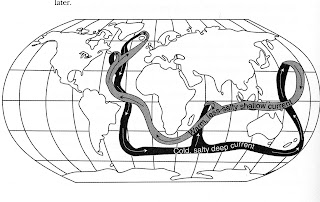 Climatologists have nicknamed it 'The Great Conveyor'. It is a massive flow judged to be as much as 100 times that of the Amazon River. Starting at the part we call The Gulf Stream, warm water flows northwards towards Greenland and Labrador becoming saltier and cooler. At the top of the loop, it sinks to the lower depths and turns southwards, eventually entering the southern oceans before moving east past the Antarctic and then up into the north Pacific. The final part of the loop returns westwards along the Equator, around Africa and back up into the Atlantic, warming and becoming more saline. A drop of water, taking this amazing journey, would be in transit for about a thousand years!
Should the Great Conveyor slow or even stall, less heat reaches the northern latitudes. The ice sheet will grow. Instead being warmer and wetter than Canada, making agriculture impossible, Europe would become cold and dry leading to crop failures. This could be the 'Crunch Current".
Climate science also informs us that the past 15,000 years has been a period of exceptional climate stability, just warm and wet enough to favor the development of agriculture. Prior to this, our human ancestors had to cope with the vicissitudes of two great ice ages. There were not a lot of us back then and it is even possible that the human population was sometimes reduced to thousands. Our effect on climate was virtually nil.
During the ice ages lots of snow and ice covered the poles and extended down to the mid -latitudes. The earth received less heat and tended to stay cold. The regular change in the earth's orbit and in the orientation of the poles resulted in warming and the end of each ice age.
The atmospheric winds and ocean currents adjust the amount of ice around the poles by transferring heat from the hotter equator, the air and sea each doing about half the work. One current in particular, the huge current that contains the Gulf Stream, has attracted attention as it appears to influence the climatic 'flip flops' signs of which are found in the ice and sediment records.
 Climatologists have nicknamed it 'The Great Conveyor'. It is a massive flow judged to be as much as 100 times that of the Amazon River. Starting at the part we call The Gulf Stream, warm water flows northwards towards Greenland and Labrador becoming saltier and cooler. At the top of the loop, it sinks to the lower depths and turns southwards, eventually entering the southern oceans before moving east past the Antarctic and then up into the north Pacific. The final part of the loop returns westwards along the Equator, around Africa and back up into the Atlantic, warming and becoming more saline. A drop of water, taking this amazing journey, would be in transit for about a thousand years!
 Should the Great Conveyor slow or even stall, less heat reaches the northern latitudes. The ice sheet will grow. Instead being warmer and wetter than Canada, making agriculture impossible, Europe would become cold and dry leading to crop failures. This could be the 'Crunch Current".
Subscribe to:
Posts (Atom)

