MY LAST POST almost a month past!!!
We have all since had the Holiday Season and entered the New Year...not much news there.
I took myself off to Basalt, Colorado, to visit with my daughter Bronwyn and granddaughter, Stephanie, for a week or so over Christmas, traveling by air from my local airport (Elmira) to Denver and then by Greyhound Bus and local bust the rest of the way. Due to weather, all flights were delayed but in such a way as to permit, as if by a miracle, connections all the way to Denver. Eventually, I arrived just before midnight ensuring the night at the airport. A good many others were in the same situation. Given the vagaries of the weather and the straits of airport security, I wished I had gone with my original intention and gone the entire way by train. In fact, the security experience on the return journey, beginning at Denver, was by far the worse...why do we bother to fly, I wondered.
A highlight of my visit was seeing Stephanie take part in The Nutcracker Suite. The entire production was most professional and with the venue the Aspen High School Auditorium. My first time to see this ballet as part of an audience. Wonderfully magical and completely enthralling!!!
Apart from that, it was almost every day skiing around the Aspen golf course. The snow was just great for cross country skiing and the Aspen network of groomed trails is quite splendid extending many miles up and down the valley. Aspen is not just a pretty place for those rich downhill ski and snowboard freaks. Like many other places this winter, record snow with good falls most nights. Corning and Painted Post have not missed out on the snow so plenty of shoveling awaited me on my return.
I have now returned to student hood...enrolled at the local community college in a French language course for the Spring Semester. A little strange to be a senior on campus, I do admit.
At this time, the world economy seems to be in desperate straights. Money and credit have dried up here in the US meaning we have slowed our spending on goods made in China. In turn, China's economy has slowed considerably with the effect that it no longer needs the resources it had been importing from Australia...and so it goes. In part, this goes back to the failure of credit due to abuses within the financial industry. Previously I circulated the NY Times article by Michael Lewis giving an insider's view of the workings of Wall Street and have since read his book, Liar's Poker. This details his experiences as a trader with Salomon Brothers up to the time of the 1987 Crash and his leaving the industry soon after. If you want to be definitely scared by the craziness within financial markets, this is the book to read.
Looking back on 2008, I realize my reading has covered many areas including Peak Oil, the interconnectedness of all life on earth, and the dangers of our relentless mining of the planet. Our economy seems to have been based on digging up more of everything and burying more and more of the resultant waste. With a little luck and lots of good management, it is possible that this recession (bordering depression) may give a breathing space in which we can discover a less damaging form of capitalism and a saner method of managing money. Perhaps we can use less and still be happy?
Monday, January 12, 2009

Sunday, December 14, 2008
JUMPING BACK IN

LAST WEEK'S ISSUE OF TIME had a very readable article on the problems of water use and availability ("Dying For A Drink"). The picture, from that article, is of Lake Mead. In 1995, when I was living in Arizona, this reservoir was full and now is nearing empty.
I have included the Web reference this in my most recent email to you. I also recommend three books:
Two are by Fred Pierce, a science writer, who has made quite a study of the matter,
"When the Rivers Run Dry: Water - the defining crisis of the Twenty-First Century", and " With Speed and Violence: Why scientists fear tipping points in climate change" (a more general examination of climate change).
The third is by Diane Raines Ward, "Water Wars: Drought, Flood, Folly, and the Politics of Thirst". I particularly like this book as it gives a wonderful account of the great Snowy River Scheme in Australia, modeled on the Tennessee Valley Authority but superior to it in many ways. As mentioned in a previous posting, there is quite a literature on this topic; these are the most recent I have been able to get from our local library system.
Of course, I will be amazed if you all read all of the above. At least check out the Time article. With all that is going on...the world economies in recession, dwindling savings, the venality of politicians, and worse than useless waging of wars...I hesitate to urge you to read more bad news. Here in the US, it is clear that the next President will have his hands more than full. What can we do as individuals, we might well wonder?
It is really hard to know. As an example, would I buy the new plug in Volt when it becomes available? Oh well, most of you know I am more likely to stay with my 1991 Infiniti G20 which (it at 293,000 miles and I at 71 years) bids fair to outlast me and be my last motor car! Going with the argument...this car will be a "plug in" which means that you can recharge is at night and not spend a cent on fuel so long as you do not exceed the 40 miles battery capacity. Sixty percent of driving in the US has to do with getting to work and back and many will not exceed the 40 miles per day this car promises. Charging up a night will suit the power utilities as this will be 'off peak' power, at least for a while until millions of cars are recharging at night. Wind power will help as more and more wind farms are commissioned, and assuming that the power transmission grids will have been enlarged to take this additional quantity of power.
But consider that burning coal is environmentally dirtier than burning gasoline and, for the foreseeable future, there is no such thing as 'clean coal'. Also, until vast improvements are made in efficiency of cooling at electrical power generating plants, it will take more water to produce that power than is involved in producing the gasoline for the same energy. If we follow T. Boone Pickens Plan, we will exchange natural gas for coal, for cars and for electrical generation as an intermediate step while alternate energy production is developed.
It looks like that what you loose on the roundabouts you pick up on the swings, as the saying goes.
I consider that totally 'plug in' cars will be a huge environmental miscalculation and maybe the Pickens Plan has a lot going for it. Running cars on compressed natural gas is certainly practical as Australia has shown (where you can fill up on liquefied natural gas at most service stations and where you can buy a new car converted to run on this fuel). Notice the link between the fuel you choose and the amount of water needed to produce that fuel. In the case of ethanol from corn that is about four gallons of water for one gallon of ethanol (not including the water needed to produce the fertilizer and the fuels for growing the corn).
Maybe we are learning the value of conservation and moderation. US motorists are driving less and driving more slowly (or were, until gasoline prices fell to current levels...I bought gas at $1.75 the other day). Consequently we are using less fuel overall and our 'persons per million miles killed' has fallen to the lowest rate in years. High efficiency lighting and slower better thought out driving can go a long way, it seems, in conserving energy. As to what to do about profligate water use, who knows what will bring us to our senses?
Last of all, two bons mots from famous Americans:
"When the well's dry we know the worth of water." -- Ben Franklin
"Whiskey is for drinking and water is for fighting over." -- Mark Twain
Of course, I will be amazed if you all read all of the above. At least check out the Time article. With all that is going on...the world economies in recession, dwindling savings, the venality of politicians, and worse than useless waging of wars...I hesitate to urge you to read more bad news. Here in the US, it is clear that the next President will have his hands more than full. What can we do as individuals, we might well wonder?
It is really hard to know. As an example, would I buy the new plug in Volt when it becomes available? Oh well, most of you know I am more likely to stay with my 1991 Infiniti G20 which (it at 293,000 miles and I at 71 years) bids fair to outlast me and be my last motor car! Going with the argument...this car will be a "plug in" which means that you can recharge is at night and not spend a cent on fuel so long as you do not exceed the 40 miles battery capacity. Sixty percent of driving in the US has to do with getting to work and back and many will not exceed the 40 miles per day this car promises. Charging up a night will suit the power utilities as this will be 'off peak' power, at least for a while until millions of cars are recharging at night. Wind power will help as more and more wind farms are commissioned, and assuming that the power transmission grids will have been enlarged to take this additional quantity of power.
But consider that burning coal is environmentally dirtier than burning gasoline and, for the foreseeable future, there is no such thing as 'clean coal'. Also, until vast improvements are made in efficiency of cooling at electrical power generating plants, it will take more water to produce that power than is involved in producing the gasoline for the same energy. If we follow T. Boone Pickens Plan, we will exchange natural gas for coal, for cars and for electrical generation as an intermediate step while alternate energy production is developed.
It looks like that what you loose on the roundabouts you pick up on the swings, as the saying goes.
I consider that totally 'plug in' cars will be a huge environmental miscalculation and maybe the Pickens Plan has a lot going for it. Running cars on compressed natural gas is certainly practical as Australia has shown (where you can fill up on liquefied natural gas at most service stations and where you can buy a new car converted to run on this fuel). Notice the link between the fuel you choose and the amount of water needed to produce that fuel. In the case of ethanol from corn that is about four gallons of water for one gallon of ethanol (not including the water needed to produce the fertilizer and the fuels for growing the corn).
Maybe we are learning the value of conservation and moderation. US motorists are driving less and driving more slowly (or were, until gasoline prices fell to current levels...I bought gas at $1.75 the other day). Consequently we are using less fuel overall and our 'persons per million miles killed' has fallen to the lowest rate in years. High efficiency lighting and slower better thought out driving can go a long way, it seems, in conserving energy. As to what to do about profligate water use, who knows what will bring us to our senses?
Last of all, two bons mots from famous Americans:
"When the well's dry we know the worth of water." -- Ben Franklin
"Whiskey is for drinking and water is for fighting over." -- Mark Twain
A WEEK OF SNOW
THE SNOW CAME AND WENT AND THEN CAME AGAIN
This time, we got seven inches or so (that's about 18 cm). The heavy falls came over two days and we had about three inches late in the evening of the first day. I thought to myself, 'You should get out there and shovel that off the driveway while it is light and fluffy.' Of course, I did nothing of the sort and had to tackle four more inches sitting on top of the now heavy snow from the previous day. Never mind...nothing like a little snow shoveling at six in the morning! Ha...as I write this I am listening to the news from Portland where you are getting much the same.
 For those of you who liked the Fall picture from the back deck, here is how it looks now. With the temperature down between 20 and 30 deg F, I have been thinking of skiing and have been at waxing skis off and on. As the snow persisted and stayed dry, I finally went down to the shed and got out my wider, back country skis and took a tour around the property.
Behold, cross country ski trails at Painted Post. Altogether, I managed to get about 200 yards of trails to ski about and those of you who might at one time have had a ski outing with me back in my days as a week end ski instructor might recall all that tramping about on skit to make skiable slopes might recognize this bit of work below.
I got about two days of skiing out of this. I took off to Pinnacle Peak Golf Course (Nine holes of skiing and tobogganing just now) this Sunday afternoon.
 This is the highest point around here with great views all around but, alas, the snow was just damp enough to clump underfoot (well, underski, if you get my meaning). Lacking glide wax, I fairly soon gave it away.
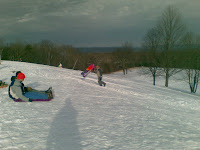.jpg) With my trusty cell phone camera, I took a shot or two so you can get an idea of the conditions there.
With my trusty cell phone camera, I took a shot or two so you can get an idea of the conditions there.
There were about a dozen or so having fun on the slope below the clubhouse. No golf today!
Uma caught me at it in the back yard so Here I am...
This time, we got seven inches or so (that's about 18 cm). The heavy falls came over two days and we had about three inches late in the evening of the first day. I thought to myself, 'You should get out there and shovel that off the driveway while it is light and fluffy.' Of course, I did nothing of the sort and had to tackle four more inches sitting on top of the now heavy snow from the previous day. Never mind...nothing like a little snow shoveling at six in the morning! Ha...as I write this I am listening to the news from Portland where you are getting much the same.
 For those of you who liked the Fall picture from the back deck, here is how it looks now. With the temperature down between 20 and 30 deg F, I have been thinking of skiing and have been at waxing skis off and on. As the snow persisted and stayed dry, I finally went down to the shed and got out my wider, back country skis and took a tour around the property.
Behold, cross country ski trails at Painted Post. Altogether, I managed
 to get about 200 yards of trails to ski about and those of you who might at one time have had a ski outing with me back in my days as a week end ski instructor might recall all that tramping about on skit to make skiable slopes might recognize this bit of work below.
I got about two days of skiing out of this. I took off to Pinnacle Peak Golf Course (Nine holes of skiing and tobogganing just now) this Sunday afternoon.
 This is the highest point around here with great views all around but, alas, the snow was just damp enough to clump underfoot (well, underski, if you get my meaning). Lacking glide wax, I fairly soon gave it away.
.jpg) With my trusty cell phone camera, I took a shot or two so you can get an idea of the conditions there.
With my trusty cell phone camera, I took a shot or two so you can get an idea of the conditions there.There were about a dozen or so having fun on the slope below the clubhouse. No golf today!
Uma caught me at it in the back yard so Here I am...

Tuesday, December 2, 2008
OVER MY HEAD IN WATER...

I HAVE BEEN READING QUITE A BIT about what we are doing with all the water in the world. At a practical level, there has been a bit of snow clearing from the driveway and some shoving of snow from off my car. For now, the snow has gone away but the temperatures keep around freezing point. Yesterday (Monday) was an exception with the temperature rocketing to the mid-40s; I ventured out into the garden and even took Uma's scooter out for a spin around the block.
 I suppose that one thing that retirees can do is to read lots of books that just happen to interest and then pass on some of that to others via a blog, which seems to be just what I am doing. I have been amazed at how much literature there is about our use of water. There seems to be so much to discover about this that I feel more than a little overwhelmed by it all.
About 200 years back, an English clergyman, Thomas Malthus, got worried about the relationship between population and food supplies. Dear Rev. Tom figured that, since food supplies increase linearly and populations increase exponentially, eventually there would be more people in the world than could be fed putting the human race into a precarious situation. I am sure he had no idea how may people would be on the face of the earth 200 years on. The Rev. Tom's ideas have been quite influential in several areas of science, economics, and population dynamics. He was a skeptic about the promised benefits of the looming industrial revolution and, while the grim conclusions arising from his analysis have been delayed in fulfillment, what with the industrialization of food production, the Green Revolution, and the like, it has taken until our own time for his ideas to have their full impact.
One of the 'and the like's has been the phenomenal increase in the use of irrigation in agriculture since his writing. Humans have been irrigating crops for thousands of years because water is like magic when it comes to increasing food production. It takes around 1,000 tons of water to produce a ton of wheat (and lots, lots more to produce a ton of corn) and, if you are relying on rainfall you get just one good crop per year. With irrigation we can produce wheat and other food even in the dessert, multiply yields many times over, and have two or even three crops each year from the same piece of land. So, if you can put 3,000 tons of water onto the ground you stand to get three tons of wheat where you would have only gotten one. Not bad, eh! Actually, completely astonishing!
The good old Brits got modern irrigation going in India about the time that Malthus was writing his stuff about how the world would one day run out of food enough to feed its growing population. Not content with just improving what the Indian farmers had been doing for thousands of year, the Brits build new canals, barrages and dams. When American engineers got wind of this, they got busy with irrigation during the settlement of the West. They learned to make even bigger dams than the Brits had managed to do and soon, using American methods, those Brits were doing the same all over their Empire and also in places like Egypt.
Today, 40% of food is produced through irrigation. Despite this being the Water Planet, only a very small portion is fresh enough to drink or to use for agricultural and industrial purposes. Most fresh water is under ground so, once centrifugal pumps became available, it was not long before farmers were pumping water out of the huge aquifers as well as diverting it from river systems and lakes. There are problems with adding all this water to the land that were not easily foreseen when the irrigation is started. A big problem is rising soil salination; eventually this can stop farming on the land affected so that the amount of land suitable for agriculture actually begins to diminish. This problem may not be insoluble (sorry about the pun) but it will take a lot of money to research it and change farming practices. Another is that we are using water faster faster than it is being replenished by natural cycles.
Still another problem is that the supply of water for human use and for agriculture is also diminishing. This is due to industrial pollution of water on the surface and underground. As an example, where I live there are considerable gas bearing shale formations underground. To get significant amounts of gas out of these formations it is necessary to drill horizontal wells (down into the shale and then sideways) and then to pump in water and sand to fracture the shale and allow the gas to escape and be collected. This takes a million or so gallons of water per drilled, productive well. When the water returns to the surface it bears the sand and lots of other 'gunk' likely as not rendering this water unusable ass well as polluting steams and aquifers. I am sure each of you readers know of similar instances of industrial pollution.
Expanding cities result not only act to reduce farmland by covering agricultural land by buildings, parking lots, and roads that also interferes with hydrological cycle as well as the run off, with pollutants, going straight into rivers and lakes. In the US, road surfaces cover an area equal to the size of Kansas, not counting parking lots that occupy more space than do buildings in most cities. Another effect of cities is to divert water from agriculture as the balance of population shifts from rural to urban living.
Enough of this! Reading in this area is entirely depressing and I warn you not to proceed. It is very hard to know what any individual can do about it, unless you happen to be a Maude Barlow (read her books).
Well, the thing is that there is a fixed amount of water on this planet (disregarding the minute amounts added via small meteorites and comets entering the atmosphere). Surface water is increasingly polluted through population increase, agriculture, and industry. Under pressure to grow more crops, farmers the world over are pumping water out of aquifers faster than the replenishment rate even while available productive land is diminishing. Oh...and then there is global warming possibly resulting in warming and drying of land currently used for food production.
This all too much!!! Maybe Malthus finally has a point.
Thursday, November 20, 2008
AN ELECTRIC STOVE!!!
I HOPE YOU WERE AMUSED by the image of a small boy, long ago, wondering how an electric stove could possibly work. Within a year or so, we had an electric stove although my mother continued to use a wood stove most of the time, especially in the cooler months. So the daily drill of cutting kindling still fell to me even as my father, now home from The War, took over splitting wood.
A correction on the last posting. It seems that producing gas fuel from the partial combustion of wood products is alive and well here and there, even here in the US. What results from this process (in which wood or similar stock is slowly combusted at high temperatures and in an impoverished oxygen environment) is not methane but CO gas and, if steam is introduced, hydrogen. Depending on the density of the wood, each load in the generator can take a car up to 200 miles. However the conversion is limited to carburetor engines or diesels. Try Googling 'gas producer cars' and see where this takes you.
By the time I was a teenager, oil was cheap and plentiful and cars were becoming more common. In Adelaide, my home city, almost everyone used public transport to get about, or else, cycles. Every main street or road had tramway (street car) tracks or electric trolley buses but the City Fathers determined that these were getting in the way of cars. Traffic was slowed because the trams had right of way, as did passengers alighting from them. Also, at street crossing where there were trams you had to use a special turn that increasingly held up traffic. So all the trams were replaced by diesel buses. The only Australian city that held back from this was Melbourne, a delightful city that still has those trams and one can just hop on them for a block or two to get about. However, drivers still have to execute that weird turn. As you may know, in the US, the motor manufacturing companies bought up the street car networks and then closed them down! I wonder why.
At the time, this seemed to make a lot of sense although there were, inevitably, the old stagers who resisted this modern advance. 'This is not progress at all', they protested. After all, rail transport was converting to diesel, so why not make a clean sweep of it? And oil was cheap...
Despite growing up in the dry mid-North where water was always in short supply if you had to rely on rainwater, life in the city led me to think that two materials were seemingly inexhaustible: Oil and Water.
Now we have looming the two scepters: Peak Oil and Peak Water. In our energy based society, we are beginning to realize that it is not only true, as the saying goes, 'oil and water don't mix' but they actually work against each other. It take water to produce the gas we buy at the pump, the coal or natural gas to produce the electricity we use in our homes, and the natural gas for heating, and it increasingly takes energy to supply water for agriculture and urban use. Pumping water into California, for instance, is the biggest power consumer for that state. Desalination plants are mind-boggling users of electrical power.
Best to read the special issue in Scientific American Earth 3 series, 'Energy versus Water' to get a good grasp of this looming crisis; the URL is in my latest email to you. Fresh water turns out to be relatively scarce and is getting scarcer. In 1996, Vice President of the World Bank Ismail Seregaldin predicted, 'the wars of this century would be over water. It is the oil of the 21st Century'.
If this even halfway true, then the biggest issue to confront and solve is how to get more energy from wind, sun, and tide and less and less from sources that use up that familiar but precious resource essential to life and of which we are mainly made...water.
Thanks to my daughter, Elizabeth (who lives in Adelaide, capitol of the driest state in the driest continent in the world) for drawing to my attention the Scientific American article mentioned above.
A correction on the last posting. It seems that producing gas fuel from the partial combustion of wood products is alive and well here and there, even here in the US. What results from this process (in which wood or similar stock is slowly combusted at high temperatures and in an impoverished oxygen environment) is not methane but CO gas and, if steam is introduced, hydrogen. Depending on the density of the wood, each load in the generator can take a car up to 200 miles. However the conversion is limited to carburetor engines or diesels. Try Googling 'gas producer cars' and see where this takes you.
By the time I was a teenager, oil was cheap and plentiful and cars were becoming more common. In Adelaide, my home city, almost everyone used public transport to get about, or else, cycles. Every main street or road had tramway (street car) tracks or electric trolley buses but the City Fathers determined that these were getting in the way of cars. Traffic was slowed because the trams had right of way, as did passengers alighting from them. Also, at street crossing where there were trams you had to use a special turn that increasingly held up traffic. So all the trams were replaced by diesel buses. The only Australian city that held back from this was Melbourne, a delightful city that still has those trams and one can just hop on them for a block or two to get about. However, drivers still have to execute that weird turn. As you may know, in the US, the motor manufacturing companies bought up the street car networks and then closed them down! I wonder why.
At the time, this seemed to make a lot of sense although there were, inevitably, the old stagers who resisted this modern advance. 'This is not progress at all', they protested. After all, rail transport was converting to diesel, so why not make a clean sweep of it? And oil was cheap...
Despite growing up in the dry mid-North where water was always in short supply if you had to rely on rainwater, life in the city led me to think that two materials were seemingly inexhaustible: Oil and Water.
Now we have looming the two scepters: Peak Oil and Peak Water. In our energy based society, we are beginning to realize that it is not only true, as the saying goes, 'oil and water don't mix' but they actually work against each other. It take water to produce the gas we buy at the pump, the coal or natural gas to produce the electricity we use in our homes, and the natural gas for heating, and it increasingly takes energy to supply water for agriculture and urban use. Pumping water into California, for instance, is the biggest power consumer for that state. Desalination plants are mind-boggling users of electrical power.
Best to read the special issue in Scientific American Earth 3 series, 'Energy versus Water' to get a good grasp of this looming crisis; the URL is in my latest email to you. Fresh water turns out to be relatively scarce and is getting scarcer. In 1996, Vice President of the World Bank Ismail Seregaldin predicted, 'the wars of this century would be over water. It is the oil of the 21st Century'.
If this even halfway true, then the biggest issue to confront and solve is how to get more energy from wind, sun, and tide and less and less from sources that use up that familiar but precious resource essential to life and of which we are mainly made...water.
Thanks to my daughter, Elizabeth (who lives in Adelaide, capitol of the driest state in the driest continent in the world) for drawing to my attention the Scientific American article mentioned above.
Monday, November 17, 2008
SIGNS OF THE TIMES
A FEW WEEKS BACK, I saw a frog. I was working in the back yard, tidying up some cuttings, on a crisp Autumn day. Suddenly, there was the frog, just at my feet! It seemed that it had been a long while since I had sighted my last frog. Reaching down, I picked up Mr. Frog (I think he was a little slowed by the cold) and together we regarded each other. After a few moments I replaced him on the ground and he hopped away slowly. Probably a little like me, this ancient frog, with a touch of arthritis in his knees.
A sign of the times, this scarcity of frogs, it seems. What with global warming, too few streams and ponds, and too many houses the world has become inhospitable for frogs. But a sign of what times, I wonder? That the times, they are a'changing? Now, when I was a lad (here we go again!) there were frogs all about. If one wanted a dozen or so frogs, they were easy to find. Often they kept you awake at night with all their croaking.
This week one of my brothers turned 83 (my other brother is 84); I bet they miss the frogs too. My birthday brother and I lived our first years on a small farm about twelve miles from a small town that was, in turn, some 85 miles north of the capital city; colloquially, we lived in the mid-North of South Australia.
How were our times? This was just before the outbreak of the second World War and toward the end of the Great Depression. You might think we lived a primitive sort of life. True, we had a motor car, and a truck, and our father had not long begun farming with a tractor having used horses in the early years of his farming life. On the other had, we had no electric power and had only a wood burning stove for cooking. No refrigerator of course, just an evaporative water cooler for keeping things cool. In the evening, our parents lit kerosene lamps. We were not cut off from the world however as we had a party line telephone and a radio that worked off a car battery (when you turned it on you had to wait for the vacuum valves to warm up so the sound came up gradually).
In America, and I suppose in the big cities of Australia, things were much more advanced. With the outbreak of war, an administration called Manpower sucked away all the casual labor left as men enlisted. My father found he could no longer run the farm and he too rejoined the Army. My mother moved into the town with my two sisters and me. My brother had moved to the city and my other brother had joined the Navy. Even in this small town, we were rapidly embroiled in the war effort. We knitted for the troops, collected all sorts of stuff to be melted down for the war industry, and wasted nothing. We grew our own vegetables as much as possible. Being in the town, we now had electric power but still had to rely of rain water collected from off the roof into two large water tanks. Alas, there was still the wood stove and the water cooler but now we also had an ice box with ice delivered! Each day the milk man called by, as did the bakery man. Every so often a grocery cart would come by or perhaps the haberdashery man. All horse drawn with the horses knowing just where to stop. The horse manure was prized for the garden!
Petrol rationing meant that only a few could continue to run motor cars; ours was put up on blocks in the garage. Some folk ran their cars on coal gas held in rubberized bags atop the bonnet (car roof) and others had gas generators mounted at the rear of the vehicle! How quaint! These used coke, wood, or coal to produce methane gas to power the car. The cars looked just like this.
With almost no cars on the roads, we rode our bikes about with complete abandon and virtually no road sense.
Looking back on it, I realize that ours was a wood and coal dependent society. If we had to travel any distance, it had to be by steam train.
Somehow we all got by. If something happened that was particularly frustrating, a common oath was, "Well, wouldn't it rip your ration cards!" Just after the war ended, the local electrical store featured an electric stove. We rushed down to see it in the store window display. How, I wondered, might a stove work on electricity?
A sign of the times, this scarcity of frogs, it seems. What with global warming, too few streams and ponds, and too many houses the world has become inhospitable for frogs. But a sign of what times, I wonder? That the times, they are a'changing? Now, when I was a lad (here we go again!) there were frogs all about. If one wanted a dozen or so frogs, they were easy to find. Often they kept you awake at night with all their croaking.
This week one of my brothers turned 83 (my other brother is 84); I bet they miss the frogs too. My birthday brother and I lived our first years on a small farm about twelve miles from a small town that was, in turn, some 85 miles north of the capital city; colloquially, we lived in the mid-North of South Australia.
How were our times? This was just before the outbreak of the second World War and toward the end of the Great Depression. You might think we lived a primitive sort of life. True, we had a motor car, and a truck, and our father had not long begun farming with a tractor having used horses in the early years of his farming life. On the other had, we had no electric power and had only a wood burning stove for cooking. No refrigerator of course, just an evaporative water cooler for keeping things cool. In the evening, our parents lit kerosene lamps. We were not cut off from the world however as we had a party line telephone and a radio that worked off a car battery (when you turned it on you had to wait for the vacuum valves to warm up so the sound came up gradually).
In America, and I suppose in the big cities of Australia, things were much more advanced. With the outbreak of war, an administration called Manpower sucked away all the casual labor left as men enlisted. My father found he could no longer run the farm and he too rejoined the Army. My mother moved into the town with my two sisters and me. My brother had moved to the city and my other brother had joined the Navy. Even in this small town, we were rapidly embroiled in the war effort. We knitted for the troops, collected all sorts of stuff to be melted down for the war industry, and wasted nothing. We grew our own vegetables as much as possible. Being in the town, we now had electric power but still had to rely of rain water collected from off the roof into two large water tanks. Alas, there was still the wood stove and the water cooler but now we also had an ice box with ice delivered! Each day the milk man called by, as did the bakery man. Every so often a grocery cart would come by or perhaps the haberdashery man. All horse drawn with the horses knowing just where to stop. The horse manure was prized for the garden!
Petrol rationing meant that only a few could continue to run motor cars; ours was put up on blocks in the garage. Some folk ran their cars on coal gas held in rubberized bags atop the bonnet (car roof) and others had gas generators mounted at the rear of the vehicle!
 How quaint! These used coke, wood, or coal to produce methane gas to power the car. The cars looked just like this.
With almost no cars on the roads, we rode our bikes about with complete abandon and virtually no road sense.
Looking back on it, I realize that ours was a wood and coal dependent society. If we had to travel any distance, it had to be by steam train.
Somehow we all got by. If something happened that was particularly frustrating, a common oath was, "Well, wouldn't it rip your ration cards!" Just after the war ended, the local electrical store featured an electric stove. We rushed down to see it in the store window display. How, I wondered, might a stove work on electricity?
Wednesday, November 12, 2008
ELECTION REFLECTION
ELECTION DAY 2008 was the first time I actually attended a polling station since becoming a US citizen. Not wanting to wait in line, the people in our house arrived well before opening time. I got to be the first person to vote and by the time I had voted, there was quite a line of folk waiting for their turn. I had previously voted but, as a Washington State resident, I had voted by mail (by poking chads out of an IBM computer card and sending it back by post). However, this was my first Presidential Election.
As noted in my earlier posting, I admit I was a little apprehensive about using the machine (instead of poking out chads or, as in Australia, using pencil and paper to record my ballot) but everyone was friendly and helpful. The machine was one of the older type and simple enough to use. Now, in the aftermath of that historic day, I have found myself musing on some of the differences between the two countries of which I am a citizen in the handing over of power.
Things are a little more complicated in this part of the world. The President is independent from the Congress and may not always have support from his own party even when it has the majority in the house of representatives. In my other land, the leader of the party that wins the election becomes the Prime Minister and is active in the lower house, hopefully busy on putting into place policies argued during the election period. It gets a little more complicated if the Prime Minister (PM) leads a minority government and has to contend with getting a bunch of independent members to support government policy. Even so, the PM can expect to have the support of his party. With the US style separation of powers, this t'aint necessarily so.
Then there is the long transition period between the election in early November and the Inauguration of the President late in the following January. So you have a 'Lame Duck' President on the one hand, and the chap you have just elected on the sidelines waiting to assume power. Elsewhere one week it is the current PM and, once the election is finished, it is the next PM...move out and move in!
When things are relatively stable, this ought not produce much anxiety...but, with things in crisis on the financial, and perhaps also, political front it makes the hair stand up on the back of my neck just a tad. A urgent question seems to be, Having gone to so much trouble to get a President, how can we ensure he gets sufficient support from his party?
President-Elect Obama seems like a very smart fellow and very much inclined to surround himself with chaps just as smart or more so. He has the quality of listening to others, or so it would appear, and his Vice President-Elect certainly knows how the ropes work in Washington, DC. However, there are powerful senior congress members and senators who might easily thwart his intentions...not to mention that hidden body of government in the US, the kingdom of lobbyists. Let's hope too that the Fourth Estate, the press, will take the role of independent criticism of government and formulation of issues seriously. That would be a change from their performance over the last eight years. Rather too many of them, for comfort, are under the control of that ex-Australian press mogul.
I guess this means that we all have to be on our mettle and to be sure to give the new President the sustained support he will need to guide the US through extremely difficult times.
As noted in my earlier posting, I admit I was a little apprehensive about using the machine (instead of poking out chads or, as in Australia, using pencil and paper to record my ballot) but everyone was friendly and helpful. The machine was one of the older type and simple enough to use. Now, in the aftermath of that historic day, I have found myself musing on some of the differences between the two countries of which I am a citizen in the handing over of power.
Things are a little more complicated in this part of the world. The President is independent from the Congress and may not always have support from his own party even when it has the majority in the house of representatives. In my other land, the leader of the party that wins the election becomes the Prime Minister and is active in the lower house, hopefully busy on putting into place policies argued during the election period. It gets a little more complicated if the Prime Minister (PM) leads a minority government and has to contend with getting a bunch of independent members to support government policy. Even so, the PM can expect to have the support of his party. With the US style separation of powers, this t'aint necessarily so.
Then there is the long transition period between the election in early November and the Inauguration of the President late in the following January. So you have a 'Lame Duck' President on the one hand, and the chap you have just elected on the sidelines waiting to assume power. Elsewhere one week it is the current PM and, once the election is finished, it is the next PM...move out and move in!
When things are relatively stable, this ought not produce much anxiety...but, with things in crisis on the financial, and perhaps also, political front it makes the hair stand up on the back of my neck just a tad. A urgent question seems to be, Having gone to so much trouble to get a President, how can we ensure he gets sufficient support from his party?
President-Elect Obama seems like a very smart fellow and very much inclined to surround himself with chaps just as smart or more so. He has the quality of listening to others, or so it would appear, and his Vice President-Elect certainly knows how the ropes work in Washington, DC. However, there are powerful senior congress members and senators who might easily thwart his intentions...not to mention that hidden body of government in the US, the kingdom of lobbyists. Let's hope too that the Fourth Estate, the press, will take the role of independent criticism of government and formulation of issues seriously. That would be a change from their performance over the last eight years. Rather too many of them, for comfort, are under the control of that ex-Australian press mogul.
I guess this means that we all have to be on our mettle and to be sure to give the new President the sustained support he will need to guide the US through extremely difficult times.
Subscribe to:
Posts (Atom)

