I DID SOMETHING NEW THIS WEEK.venturing once more into the breech of health care, I went to my first Town Meeting. Town Meetings are much more the thing here in the NE than I recall them being in the NW. On Monday, in the auditorium of a local high school, Congressman Massa (Corning-D) met with some 800 local folk to discuss health care reform issues. I was impressed by several things. One was the size of the auditorium; high schools here in the US are really big. About half the attendees were Medicare recipients (by show of hands) but there were also quite a few young folk present.
More significantly, I was impressed at the way the Congressman ran the meeting; he spoke for several minutes, then the rest of the two hours was open for questions. As you may have read, some of these across-the-nation public meetings have been marked by outbursts of ill-tempered excitement. Predictably, there were plenty of placards and slogans, but everyone kept their temper and maintained a polite approach.
One of the big issues is the cost of care. The US spends about twice as much per person on health services as do other developed countries but falls short of universal health care. It is useful to look at come of the components of cost. At the bottom is the cost of doing business for a medical practice. Billing is a considerable part of the cost of care. In the US, billing is based on the extremely complex CPT coding system and medical practices must purchase expensive electronic billing systems to submit claims. This is a fertile arena for disputing claims from the viewpoint of the insurer. Challenging disputed claims involves additional expensive software, often vended by subsidiaries of the insurance companies. The physician I see has observed that up to 40% of his day may be given over to negotiating treatments for patients with insurers. A pity, as this raises the per patient per day cost of care.
Not that one can particularly take issue with the health insurers. They compete for insurance contracts with other companies and often have to pare premiums to the penny to get the business. They then must control claims so as to stay inside the total premium income. The point of this is that the considerable cost of doing business has to be included in the per treatment cost of health care, thus raising the price a doctor must charge in order to stay in business. This has been well summarized by Paul Krugman, "So it’s an arms race between insurers, who deploy software and manpower trying to find claims they can reject, and doctors and hospitals, who deploy their own forces in an effort to outsmart or challenge the insurers. And the cost of this arms race ends up being borne by the public, in the form of higher health care prices and higher insurance premiums." The cost of this 'arms race' has been estimated to add upwards of $US 45 billion to the cost of health care.
It has been argued that the cost of malpractice insurance can be very considerable and that a practitioner may order multiple and possible unnecessary lab tests to guard against possible malpractice suit, adding to the total cost of health care. However, the report of a recent study suggests this is relatively slight. A more likely villain is the marketing practices of the larger drug companies.
For example, the considerable effect of advertising by drug companies encouraging you to 'ask your doctor' or 'tell your doctor' about some new medication or test. This adds significantly to the cost of care. Very few developed countries permit this type of advertising. A review of rising costs in the Canadian health system some 20 years ago showed that the main cause was unnecessary tests and procedures.
As to the costs of medications (much dearer in the US than elsewhere), consider the effect of the cost of marketing by drug companies to the medical profession. This week a large company was fined $US 2.3 billion for fraudulent marketing and was labeled a 'repeat offender'. It is illuminating to read how this company went about marketing drugs to doctors. Consider how the fine plus the cost of the actual marketing practices adds to the cost of the prescription pills you buy. As one doctor remarked to me, 'You don't know how much money there is in the world until you meet the drug companies; they have more money than God!'. Collectively, the drug companies and health insurers spend amazingly large amounts on lobbying politicians. Here a little, there a little, all this adds to the cost of care. According to a 2005 analysis by McKinsey & C0, the costs of important components of health care are between 2.2 and 4 times higher in the US than in peer developed countries, despite that we use fewer medications and spend less time in hospital.
The cost of care in the US is quite a tangled web and therefore not amenable to an easy fix. The Town Hall meeting got me going, as you can tell, pulling together numerous threads I have encountered these last two years. Therefore, I like the Congressman's proposition that, instead of one piece of legislation passed in relative haste, it may be better by far to understand this web and bite off pieces of the apple one important bit a a time. In the meantime I keep in mind that there are several players of influence whose interest it is to keep things pretty much as they are. Unfortunately, this is at the very considerable expense of the rest of us.
Coincidentally, I received in the mail today from my health insurance company the latest one inch (2.54 cm) thick directory of the practitioners who are in the network. Goodness know what it cost to prepare, print, and post. I never would have received such a publication in Australia, when I lived there, as I was free to see any practitioner, usually on the same or the next day. Well, that is 'socialized medicine' for you.
Now, where is that chap with the sign?
Thursday, September 3, 2009

Thursday, August 27, 2009
A COUPLE OF THINGS ONE SHOULD AVOID
ONE IS, CATCHING A COLD; THE OTHER: FALLING OFF A BIKE. Neither is pleasant and, taken together, quite debilitating. I suppose anyone can catch a cold. It requires no special talent. Coming at it another way, it helps to wash one's hand frequently if in a crowded place and meeting strangers. I may have neglected these precautions a week or so back when visiting friends at the Chautauqua Institution. They did not have colds but there must have been one lurking as I came down quickly with a sore throat and the infection dived without delay into the shelter of my lungs.
Before my cold really set in, I was riding my bike back from the local library after a thundershower and thought to take a short cut to avoid traffic. The front tire of my bike struck a low kerb at about 45 degrees and slipped sideways, pitching me to the pavement. This must require some special talent as I have now managed this twice on the same bike. It may be bike specific as, in twelve years of riding it, I have never fallen off my other bike. The split second of falling affords time for just a small thought, 'This is going to hurt!'. As indeed it did.
A skun knee and elbow, as well a mashed and sprained thumb, do make for discomfort. Also, there are the hard to define aches from the fall. These have a special contribution when producing a hacking cough. Ah well, I am just about over it and in the mood to attempt a new posting. I celebrate escape from small miseries. Too bad I can't show photos. The good thing is, my bike was not even scratched.
Have you ever heard of the Hegelian Dialectic? Nothing to do with falling off a bike or catching a cold. This refers to a process whereby opposing views may lead to eventual agreement: comprising three dialectical stages of development: beginning with a thesis, followed by its reaction, an antitheses, contradicting the thesis, and the tension between the two being resolved by means of a synthesis.
Right now, in the political debate here in the US about health care reform, we are in the midst of clash of thesis and antithesis. I am keeping out of it. The last time I wrote about health, some reader slapped a 'possibly subversive' label on my blog! I must have said something sensible. Mostly, I despair of the political process and wonder if a useful synthesis can be attained. For an illuminating shaft of light, I invite you to look at Nicholas Kristov's column in NY Times (Health Care Fit For Animals), just right click on the title to go to the article.
The dialectic to which I mean to refer is the global warming debate. Not whether the world's climate is warming, which it has been doing since the end of the last Ice Age some 16,000 years back (with a slight backward step with the Little Ice Age). We are in one of those short inter-glacial periods with another Ice Age somewhere in the future. It seems like the next planet out from the Sun, Mars, is also warming. However, the Martians (who don't exist) do not seem to be part of the cause.
Back in the 1970s, the big concern was that our planet might be cooling, rapidly approaching the next icing over. Now we are concerned about the warming. We have had the most unreasonable weather around here (hardly any sunny days, rain, rain, and more rain, and lots of thunderstorms). The cause of this? Almost everyone agrees it is due to global warming; as well it might (or not, as the case may be).
My friend Brian, in Vancouver, recently drew my attention to the work of Lawrence Solomon who has just published a book, The Deniers, in which he displays the interplay of thesis and antithesis on the possible role of our use of fossil fuels, which may lead to catastrophic climate change effects. What, I thought, isn't this all settled? Everyone knows that our heedless use of fossil fuels is getting us into serious soup. So I jumped to good old Amazon.com and ordered the book. Two days later (how do they deliver so fast?) the book arrived and I have skimmed through it for the most part and read some sections really carefully. I was amazed to find that there are lots of serious, respected climate scientists, geologists, and the like, who do not agree that this proposition is any 'slam dunk'.
You may or may not be interested in this debate and I do not propose to bore you further, just to remind you of the wisdom of the old song, 'Tain't necessarily so...'. You can find out more by Googling 'Lawrence Solomon'. In my old age, it is good to find that things may not be quite as bad as they may be made to appear. With some years yet to run, I look forward to the synthesis.
In the meantime, no harm in using less gasoline (petrol), conserving energy, revitalizing our energy infrastructure, and developing alternate energy sources. I am not so sure about carbon credits, could be a lot of mischief down that track even though there seems mounting enthusiasm for this approach. Why not a simple carbon tax (like in Denmark where it seems to work quite well)? Well, who wants another tax? Maybe the government could do with the money. As for carbon trading, there may be a lot of profit in that and even the possibility of derivatives (future trading and option trading). Wait a minute, haven't we just had a bad brush with that sort of thing?
I have to go...I think I see someone dashing up, waving a "Possibly Subversive" sign.
Friday, July 31, 2009
WWOOFING IT IN SW FRANCE

I FOUND OUT ABOUT WWOOFING through the Frugal Traveler column in NY Times. Just by Googling 'wwoofing' you can get a wealth of information to start you on your travels in just about any country. WWOOF is a world wide organization that links to opportunities to live and work on organic farms. In previous posts I have described how I journeyed to and from my wwoofing experience in the Ariege Region in South West France, adjoining the Spanish border. Quite a journey from the small rural community around Corning/Painted Post (Upper NY State) to the small rural community around St. Girons, Ariege, the best part of which were the long rides through the lovely French countryside absolutely alone in the sense that hardly a soul in that part of the world had any knowledge of me. This may seem curious to you but I recommend the experience of solitude.
My hosts were Erwin and Jasmin Berg who, for the past 12 years have owned and run an organic farm of 40 hectares in the hamlet of Rames, near Moulis, near St. Girons, in the very hilly beginnings of the Pyrenees
 . You can Google-Map these places to see the region. Here are my hosts. They are dear people whom I am now very pleased to count as friends. They have hosted many wwoofers over the past decade and have wwoofer friends all around the world. Besides being hard working, they are wonderfully welcoming and kind; as well, they are most interesting people. Erwin is German and Jasmin was born in England. They have been traveling entertainers and Erwin is a professional glass worker (which automatically gives him entrance to Corning, the center of glass working here in the US), and also briefly ran a circus. They raise cattle and rabbits and grow produce for local markets.
I had the company of two other wwoofers (Katy and Matthieu) and also Celia who was doing her second internship on the farm as part of her studies. One of the really great experiences were mealtimes, sitting around and eating wonderful food (Jasmin is a very good cook), and talking a lot.
 Here we all are (I am out of the picture, taking the photo). From left to right, clockwise, Celia, Matthieu, Katy, Dominik (the son of the house), Erwin and Jasmin. As most of the talking was in French, I gradually became better at hearing French and I think my spoken French has improved a good bit. Both Katy and Matthieu were good tutors. Also in the company were two dogs, three puppies, several cats, and two kittens.
How did each day go? Up around 7 AM and coffee which we all seemed to need to get going. The French do not make much of breakfast (which is why it is called 'petit dejeuner' or 'little lunch') so we each were responsible for our own food. For me, that was oatmeal. Then it was off to work. This might be haymaking, weeding, digging, mulching, planting out, or cleaning out. we did a lot of haymaking since it was the season. This involved a deal of successive turning of recently cut hay and, finally, baling. It being hot and humid on haymaking days, at some altitude, and the ground steep, I can vouch that this was hard, steady work. Fortunately, being German, Erwin had a good supply of beer which we were all very glad to drink whenever available and at all times of the day, as well as copious amounts of water. Maybe I am getting too old for this? I asked myself at times! As wwoofers, we could work at our own pace and rest as necessary. I took time out to wonder at the view, especially that across the vally of the other farms.
 Even so, as part of the haymaking team, one really had to just keep up with the work. I will up-load a video of the haymaking, when it has been edited. We would take mid-morning and mid-afternoon breaks as well as for lunch and dinner. All up, a working day might be 10 hours but, apart from the hay, not hard or difficult, just pleasant and steady. Have you discovered the zen of weeding?
It was not all work. Several times I went off with Erwin to visit friends or neighbors...very pleasant and involving drinking good French wine (sometimes a good bit of wine). On another day,we all went off to explore part of an extensive cave system under the hill on which the farm was situated. My first experience of real caving. I passed on the final descent and spent some 20 minutes in complete darkness (I did have a flashlight) listening to the voices of my friends coming up from the deep...another experience of solitude. This is a well known cave system (Grotte du Portillou a Moulis, Ariege) and begins through a quite tight entrance and steep descent leading to large chambers formed by a (subterranean) river. On other days we went to the local markets at St. Girons and Engoumet. Also, I took a Saturday off to visit St. Girons and St. Livier on the day of the finish of the 8th Stage of the Tour de France at St. Girons. And then there was the pub at Engoumet where we all had a drink
 (clockwise: me, Matthieu, Celia, and Erwin), so it was hardly all work and no play.
After lengthy dinners, so beloved by the French, we would retire around 10 PM, bone tired and quickly off to sleep. Matthieu and I shared the loft above the main living area while Katy and Celia had separate quarters attached to the house. The house was built in the 19th Century and has needed (still needs) quite a bit of work. It is pictured at the top of this post. It is comfortable and has a wonderful fireplace which was just great on one cold and rainy day. We did have some cold and wet days. The locals have a couple of sayings about the weather. One is, 'If you cannot see the mountains, it is because it is raining; if you can, it is about to rain!' Another, 'We have seven months of winter and five months of terrible weather!' Living in Ariege is no picnic; as one of their story tellers (Olivier de Robert) has remarked, 'This mountainous area is never a gift for anyone..." It has long attracted folk who are suspicious of central authority, seeking a free, simple, and independent life.
Wwoofing is not everyone's idea of a vacation. It is unparalleled however as a way of entering into the life and ways of a region and of making friends. Would I do it again? I must admit that age may be working against me but...maybe once more in a wine growing area? If you like the idea and really search it out, you may be lucky enough to meet folk like Erwin and Jasmin.
Tuesday, July 21, 2009
BACK IN THE USA
 BACK IN THE USA now for almost a week and just about back to my former self. It has been hard to leave behind the experience of 'wwoofing it' in that small hamlet where Erwin and Jasmin have their 40 hectares on the steep slopes of the rising Pyrenees. What have my fellow wwoofers, Katie and Matthieu, been up to these last seven days...haymaking, digging, weeding, transplanting, or perhaps have they been up to the mountain pastures to check on the cows?
I will write about the wwoofing experience in my next post. Here I simply say a little about watching a finish of le Tour de France, the journey home, and my state of being.
Yes, I did get to see the Tour competitors go by! Through no fault of my own, I found myself in an excellent position about 400 yards from the finish, able to see about 250 yards up the hill in the direction from which the riders would be coming, and about the same distance towards the finish (which was around the corner). More of this in a moment.
The highlight of the day for me was to visit the Cite and Cathedral of St. Lizier, about two miles west of St. Girons. The town of St. Lizier, set atop a hill overlooking a beautiful valley, has a history going back to roman times while that of the cathedral goes back to the 6th Century. The cathedral is said to be made of bricks from all over France, has a beautiful adjoining cloistered garden containing a crypt and the burial places of several religious notables in the distant past. Given the steep descent from the farm and that the wind was behind me most of the way, I made it up to the cathedral in just half an hour. A baptism was in progress so I spent an hour walking around the cite streets and exploring a garden atop the hill from which are some great views of the valley and distant mountains.

Here you can see the cathedral. The crane does not go back to roman times...France is spending a lot of their economic stimulus money on refurbishing historic sites. The photo at the top is of the cloisters.
I then rode down to St. Girons along the old road joining the two towns and found myself in the small square where I had first stopped when arriving almost two weeks previously. Time for lunch. When I had finished a leisurely meal 'a la terrace', I discovered that the gendarmerie had locked the town down (must have been 200 0r so positioned along the final route). So I had to abandon my plan to ride further out of the town. I found a position right next to a TV camera and figured this would be a good spot.
So began a two and half hour wait for the action which consisted of about three quarters of an hour of 'The Caravan'... a cavalcade of all the team and sponsors, throwing out all sorts of gifts (hats, bottles of water, scarves, clappers). Then, after about 15 minutes, in came the first three riders! Several minutes later, the peloton; a hundred of so riders going past in just about 30 seconds!! At this point, one realizes that the Tour is what it is because of the TV coverage that so effectively expands the scope and detail of the racing,
It took two hours to get out of the town and on the way back to the farm.
 Here I am in St. Girons on that memorable day.
My trip home had several segments. Riding first from Rames to St. Girons and then east to Foix (with a couple of long climbs and a great lunch at a pretty hotel at the top of the final climb) where I was due to catch an overnight train to Paris, via Toulouse. However, the train drivers were still on strike and I made it to Toulouse by bus. A long wait to catch the 1:15 on Tuesday morning. Only five minutes late into Paris Austerlitz station and smooth connections to the airport. With luggage checked and customs behind me, I got trapped in a long, slow security check and nearly missed my plane. The cheers that greeted me as I took my seat were premature, unfortunately, as we then had a six hour delay due to a technical fault with one engine. However, I had good company and we actually enjoyed our conversation through the long wait. All this led to an overnight stay in Philadelphia that gave me a chance to catch my psychological breath and arrive really clean and refreshed in my local airport. Home at last!
Alive and well, bone weary after two weeks of farm work and lots of French, about five pounds lighter and not quite back into my accustomed self.
Friday, July 10, 2009
FROM THE SOUTH OF FRANCE
 I PROMISED A POSTING FROM FRANCE; so here goes.
First, thank you, Glenn for your comment.
I have been here for two weeks now (almost), writing on Friday morning July 20. After arriving in Paris (CGA) two weeks ago in the morning, I made my way to my train connection, lugging my suitcase containing the bike and my soft luggage (attached to the suitcase by bungee cords) up and down stairs with lots of help from Parisians to catch a crowed train to Toulouse. Quite an experience, sitting one's suitcase watching the world wizz by at 200 kph!
At Toulouse, I found my way to the Metro (more stairs) and then to the Youth Hostel for my two nights and one day in this very pleasant city (fourth largest in France) where everything is so compressed compared with the US (I refer to streets and houses). Sunday saw me off early with the weather fine and warming. Coffee and pain au chocolat for breakfast some 17 km down the road and soon I entered the Valley of the River Leze, catching glimpses of the distant Pyrenees at turns on the road. The day warmed and the slight wind was in my face, so I drank lots of water and an occasional beer or two at the lovely little towns along the way.
It was steady going with gradual ascent as the mountains drew nearer. The total distance was to be 112 km but my average speed took a dip by the time I had reached Le Mas d'Azil, some 77 km from Toulouse where I crossed from one valley to the next. In this area there is a large cave that has been used as a refuge over the centuries by several groups (hence the name, which means 'house of refuge'. Nowadays it is a park where both the river and the road go through the mountain from one valley to the next.
It was not too long to Saint Girons with the ride becoming easier. There I stopped for a beer and called my hosts. Just 12 km to go; no sweat I though to my self. In fact, after the village of Moulis, the road steepened very considerably. Now I know why my host had wished me, 'Bon courage, Robert'! For the final 3 km I mostly walked, pushing my bike along the quite narrow road. It is hard to accept that, some 15 years ago, the Tour de France competitors actually came down this steep, narrow, winding track to the finish at St. Girons...surely a suicide mission!
Altogether, due to the last 5 km or so, probably the toughest ride of my life.
I soon revived with a beer from my host. I had a quick look around, met the other wwoofer working on the far, had dinner and went to bed.
Since then, dear Mates, it has been farm work: digging, haymaking, weeding (being an organic farm, there is a constant war on weeds) and the occasional visit to neighbors and friends, some of whom appear to be serial murderers dedicated to the putting to death of wwoofers by the administration of large quantities of wine. We have since been joined by a third wwoofer and a fourth worker who is doing a second placement on the farm as part of here degree. Which is just as well, as there is lots of work to do and the days are long. However, they are punctuated by excellent meals and long conversations around the table.

Saturday and Sunday last, we went to the markets at St. Girons and at a small village called Engomer, more to the South. Here is a photo of my hostess, Jasmin. She and her husband, Erwin, have the farm. She does three markets each week
 Here is the market. This market is just a small village market. They had just concluded their three day 'fete de ville' and everyone was in good spirits.
At the top of this posting, you will have seen the River Lez which runs through this village and just the other side of the line of stalls you can see here. By way of contrast, the market in St. Girons is absolutely huge, flowing in all directions away from the town square and with an abundance of local produce, vegetables, fruits, meats, cheeses, shoes and other leather work, knives, garments, and much more beside
At the local, earlier an Irish Pub, I bought Erwin a beer; then he bought me one; and then, the publican bought us each another!
Lots of people come here to retire, attracted by the simplicity of life, including Germans and English, as well as French. I love it here despite that we have had a good bit of rain up in the mountains where the farm is. In the valleys, the weather is mild and town life very charming indeed. Back to the US of A next Tuesday, after riding to Foix on the Monday and the overnight train to Paris. Oh yes, and tomorrow, I will watch the finish of the eigth stage of the Tour de France at St. Girons.
Friday, June 19, 2009
GOING PAST 72
YES, I MADE IT PAST my 72nd birthday. This seems somewhat amazing to me. I have outlived my father, who just missed getting to 71 but probably will not outdo my mother who died at 102. My health is good and I do, more rather than less, the right things in regard to diet and exercise.
I suppose the main dread , given the probability of long life, is the threat of Alzheimer's disease. It looks like there are several things one can do to offset this possibility. Most are not too onerous, such as drinking several cups of coffee a day plus one or two glasses of red wine. Black and bitter drinks do no harm. Regular exercise to ensure circulation to the brain seems like a good idea. Taking aspirin each day is said to be good for vascular health and it appears that some ibuprofen (to ease the arthritic twinges in my knees) also helps offset the approach of dementia. Speaking of diet, I find I am moving in the direction of the vegetarian approach, and may even end up vegan. Certainly, I am eating much less meat and diary products; this from reading 'Dr. Neal Barnard's Program for Reversing Diabetes'. I don't have diabetes but have a high risk for it. Besides being a good read and containing useful recipes, this book seems based on solid research.
Being in a loving relationship does not harm; quite the opposite in fact.
I regret I can offer little of philosophical worth about getting older. Try to arrange oneself to enjoy each day, keep active and creative, attempt to be a contribution to others, don't give up things one did when younger; all these come to mind.
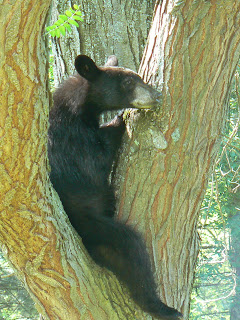 Since that fateful day, life has moved along quickly. My little garden us coming along well (we ate our first radishes the other day); a spike of excitement earlier this week when a young black bear too up residence temporarily in one of the trees in our yard.
Being interested in neurology, I am impressed by what is being discovered about the brain's ability to reconstruct itself and to lay down new neural networks in response to learning and solving problems. On this basis, I have continued my study of French language and took a course at the local community college last semester. My growing interest in gardening opened up an opportunity to complete the Master Gardener's extension course out of Cornell University; it is astonishing that some folk know so much about gardening and that there is so much to know!
Aside from taking the lawn mower apart to replace the drive belt and discovering how much easier it is to turn compost with my new portable composting bin and pitchfork (I can turn the entire heap within a half-hour), the most engaging experience has been getting ready for my trip to France. I leave on June 25th and will spend almost the entire time on an organic farm in one of the least populated areas of France, the region called Ariege. This is in the southwest of France, bordering Spain, in the slopes of the Pyrenees.
The farm is about eight miles toward the Spanish border from the ancient town of St. Girons (so you can Google-map the location). I discovered this through the The Frugal Traveler's column in NYTimes. You can find about this program by going to wwoof. One can 'wwoof'' all around the world.
But how to get there? One can do so by train and by bus but it is somewhat complicated. After dreaming about riding through the beautiful French countryside, I decided to train it from Paris to Toulouse (on the Very Fast Train), stay a day or so, and then ride the 112 Km to the farm . It is mainly flat going until the last pitch. Having worked hard with Google Maps, I now have the route worked out.
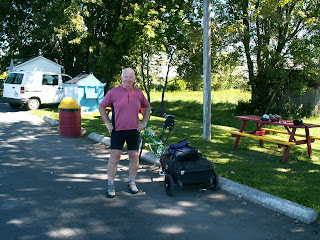
My folding bike travels in a suitcase. At my destination, out it comes and the suitcase becomes a trailer. Here I am somewhere between Quebec and Montreal back in 2006.
Would you believe that, after days of unrelenting rain here, what weather can I expect for this ride?
You've guessed it...rain showers! Still, the die is cast and I will take my chances and preprare for a wet ride.
I leave on Thursday next and will try to get a blog posting done while I am in France.
I suppose the main dread , given the probability of long life, is the threat of Alzheimer's disease. It looks like there are several things one can do to offset this possibility. Most are not too onerous, such as drinking several cups of coffee a day plus one or two glasses of red wine. Black and bitter drinks do no harm. Regular exercise to ensure circulation to the brain seems like a good idea. Taking aspirin each day is said to be good for vascular health and it appears that some ibuprofen (to ease the arthritic twinges in my knees) also helps offset the approach of dementia. Speaking of diet, I find I am moving in the direction of the vegetarian approach, and may even end up vegan. Certainly, I am eating much less meat and diary products; this from reading 'Dr. Neal Barnard's Program for Reversing Diabetes'. I don't have diabetes but have a high risk for it. Besides being a good read and containing useful recipes, this book seems based on solid research.
Being in a loving relationship does not harm; quite the opposite in fact.
I regret I can offer little of philosophical worth about getting older. Try to arrange oneself to enjoy each day, keep active and creative, attempt to be a contribution to others, don't give up things one did when younger; all these come to mind.
 Since that fateful day, life has moved along quickly. My little garden us coming along well (we ate our first radishes the other day); a spike of excitement earlier this week when a young black bear too up residence temporarily in one of the trees in our yard.
Being interested in neurology, I am impressed by what is being discovered about the brain's ability to reconstruct itself and to lay down new neural networks in response to learning and solving problems. On this basis, I have continued my study of French language and took a course at the local community college last semester. My growing interest in gardening opened up an opportunity to complete the Master Gardener's extension course out of Cornell University; it is astonishing that some folk know so much about gardening and that there is so much to know!
Aside from taking the lawn mower apart to replace the drive belt and discovering how much easier it is to turn compost with my new portable composting bin and pitchfork (I can turn the entire heap within a half-hour), the most engaging experience has been getting ready for my trip to France. I leave on June 25th and will spend almost the entire time on an organic farm in one of the least populated areas of France, the region called Ariege. This is in the southwest of France, bordering Spain, in the slopes of the Pyrenees.
The farm is about eight miles toward the Spanish border from the ancient town of St. Girons (so you can Google-map the location). I discovered this through the The Frugal Traveler's column in NYTimes. You can find about this program by going to wwoof. One can 'wwoof'' all around the world.
But how to get there? One can do so by train and by bus but it is somewhat complicated. After dreaming about riding through the beautiful French countryside, I decided to train it from Paris to Toulouse (on the Very Fast Train), stay a day or so, and then ride the 112 Km to the farm . It is mainly flat going until the last pitch. Having worked hard with Google Maps, I now have the route worked out.
My folding bike travels in a suitcase. At my destination, out it comes and the suitcase becomes a trailer. Here I am somewhere between Quebec and Montreal back in 2006.

Would you believe that, after days of unrelenting rain here, what weather can I expect for this ride?
You've guessed it...rain showers! Still, the die is cast and I will take my chances and preprare for a wet ride.
I leave on Thursday next and will try to get a blog posting done while I am in France.
Monday, May 25, 2009
LAST POST ON COMPOSTING?

HOORAY!!! NO MORE POSTS ON COMPOSTING? Well, maybe a mention occasionally but I promise not to bore you with dreary details.
Have you noticed my new profile photo? I am caught partway through making a portable composting bin and, in the process, reviving some satisfying carpentry skills. The bin is likely the final phase of compost bin construction for me; I set it up just last night. Here is the historical array, from left to right, the first to last.
As remarked in a previous post, a compost pile needs to be around 48 cubic feet (1.9 cubic metres) so that heat is retained while the myriads of microbes go about their work. A hot pile means compost faster. The catch is that the pile has to be kept aerated or else it will go anaerobic (smelly and not quite what one wants) which means that the heap has to be turned over regularly. A pitchfork helps a lot but a portable bin goes further to ease the work. The four sides are held together by 'hook and eye' latches. When the pile needs turning over one simply disassembles the bin, sets it up alongside the pile, and pitches the pile into the bin.
 Here is the latch arrangement and you can see that the frames are lined with hardware cloth (of course, chicken wire is fine too). All this will be put to the test today (Memorial Day) when I do the actual forking over.
All told, I think it took about two days work to make the bin, no doubt faster if you have a proper workshop including a bench saw that would make the cutting out faster. I admit to enjoying the construction. The frames are quite square and exactly the same size. Why the white paint? you might well ask. Well, it was the paint I had and I thought it would turn out brownish. Ah well, at least it is weather proofed and will last longer.
Apart from the benefits of composting (great for the soil structure and worms love it), I have enjoyed finding out about the entire process. Maybe I will venture into vermiculture but worms seem to be a picky bunch and have to be treated well. As I say, Watch this space....
Expect the next post to be a Birthday Post.
Subscribe to:
Posts (Atom)

